
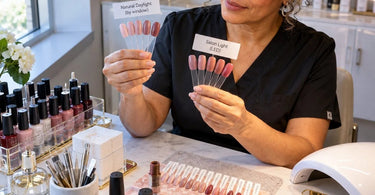
Upgrade your offerings with this gem... a little lighting knowledge that can save nail technicians from one of the most confusing moments in the manicure chair! Have you ever applied a gorgeous dusty rose gel polish, admired your flawless work under the salon lights, and then watched your client hold her hands near a window and ask why her nails suddenly look peach? You are not imagining things, and neither is your client. Nail colors genuinely can appear different under artificial salon lighting than they do in natural daylight, even when the polish formula, application, and finish remain exactly the same. Understanding why this happens helps professional nail technicians recommend shades more confidently, manage client expectations, and create a more consistent color-selection experience.
For busy nail salons, lighting is much more than a decorating decision. It influences how clients perceive polish shades, how technicians evaluate their work, and whether someone leaves loving her manicure or wondering why her sophisticated mauve suddenly looks like it has joined the coral family. The good news? A few practical lighting adjustments and a smarter consultation process can make a surprisingly big difference.
Why Nail Colors Look Different Under Salon Lighting Than Near a Window
The short answer is that different light sources contain different combinations of wavelengths. Nail polish pigments absorb some wavelengths and reflect others. The light that reaches your eyes depends on both the polish and the illumination surrounding it.
Sunlight, warm indoor bulbs, cool white LEDs, fluorescent fixtures, and decorative salon lighting do not all produce identical light. When their spectral characteristics change, the appearance of certain pigments can change along with them.
That means a polish that looks like a neutral pink under one lamp may appear warmer, cooler, brighter, duller, or slightly different in hue under another.
This effect can be particularly noticeable with:
- Dusty rose and mauve shades that sit between pink and purple.
- Nude polishes containing subtle peach, beige, or gray undertones.
- Lavender and lilac shades that can look pinker or bluer depending on illumination.
- Red polishes with orange or blue undertones.
- Milky whites and translucent pinks that reflect surrounding colors.
- Metallic, shimmer, pearl, and iridescent finishes that change with viewing angle and lighting direction.
The polish has not necessarily changed. The light illuminating it has changed, and your visual system is interpreting the reflected light under new conditions.
Meet Metamerism: The Science Behind the Nail Color Surprise
There is a scientific concept behind some of these frustrating color mysteries: metamerism.
Metamerism occurs when two colors or materials appear to match under one lighting condition but no longer match under another. This happens because the materials can have different spectral reflectance characteristics even when they produce similar visual impressions under a particular light source.
Imagine a nail technician comparing two nude polish shades beneath a salon lamp. They look nearly identical. Move the swatches into daylight, however, and one suddenly appears pinker while the other reveals a yellow-beige undertone.
That is a classic example of how lighting can reveal differences that were less noticeable before.
Strictly speaking, one polish looking different under two lights is not automatically an example of metamerism. A single color can shift in appearance simply because the illumination changes. Metamerism specifically describes a match between two colors that breaks down under different lighting.
For professional nail services, both effects matter. They explain why two shades can seem interchangeable at the manicure station yet look noticeably different outdoors, or why a client's selected color may look warmer after she leaves the salon.
Warm Salon Lighting Can Make Nail Polish Look More Yellow or Orange
Warm lighting creates an inviting salon atmosphere. It can make interiors feel welcoming, comfortable, and luxurious. Unfortunately, that same cozy glow can influence how nail colors appear.
Warm white lighting generally has a lower correlated color temperature, commonly around 2700K to 3000K. Its visual appearance is more yellow or amber than neutral or cool white lighting.
Under warm illumination, certain nail colors may appear:
- Peachier or more orange than expected.
- Less blue or violet in appearance.
- Warmer and creamier, especially with beige and nude shades.
- More golden when metallic or pearl pigments are involved.
Picture a client choosing a delicate blush polish under warm pendant lights. It looks romantic and softly pink. Then she steps outside and discovers that the same color has a cooler, slightly lavender undertone.
Neither appearance is necessarily wrong. They reflect how that polish responds to different lighting environments.
Salon owners do not need to eliminate warm decorative lighting. Instead, separating ambient lighting from the brighter, color-conscious lighting used at manicure stations can help create a comfortable atmosphere without compromising shade evaluation.
Cool White LEDs Can Make Some Nail Colors Look Bluer or Less Warm
Cool white lighting generally has a higher color temperature than warm white lighting. Depending on the lamp, it may create a crisp appearance with a more noticeable bluish character.
This can influence how certain nail polish colors are perceived.
A warm beige may appear less golden. A lavender shade may look cooler. Some reds may seem less orange, while certain pale pinks can appear more neutral.
However, color temperature alone does not tell the whole story.
Two LED lamps labeled 4000K can still render nail polish differently because their spectral output and color-rendering performance may differ. A lamp can appear pleasantly white to the eye while reproducing certain saturated colors less faithfully.
For salon professionals comparing professional nail polish shades, consistency is just as important as brightness.
What Is CRI, and Why Should Nail Technicians Care?
CRI stands for Color Rendering Index. It is a commonly used measure of how closely a light source renders a set of test colors compared with an appropriate reference illuminant.
The general CRI scale reaches 100, with higher values typically indicating better color fidelity under the metric.
For nail salons, lighting with a CRI of 90 or higher is a useful starting point when selecting lamps for stations where accurate color evaluation matters.
But there is one important detail: CRI does not describe every aspect of color rendering. Two lamps with similar CRI values may still reproduce particular reds, pinks, or saturated colors differently.
For especially color-sensitive applications, additional information about color fidelity and the rendering of saturated red can be valuable.
When evaluating LED Bright Lamps or other task lighting, salon owners can consider several specifications together:
- Color temperature: Neutral white lighting around 4000K to 5000K can provide a practical starting point for color evaluation.
- Color rendering: Look for high color fidelity, ideally with a CRI of at least 90.
- Brightness: Choose enough illumination to evaluate coverage, edges, and application details comfortably.
- Glare control: Diffused lighting helps reduce distracting reflections from glossy nails.
- Consistency: Similar lighting across manicure stations makes color comparisons more predictable.
Think of good task lighting as another professional tool. Just as a quality nail brush supports precise application, well-chosen illumination supports more dependable visual judgment.
Why Natural Daylight Often Reveals Nail Polish Undertones
Natural daylight generally offers broad spectral coverage, which can make it a useful reference for evaluating polish colors.
When a client moves her manicure toward a window, subtle undertones that were less obvious under salon lighting may become easier to distinguish.
A nude that seemed perfectly beige may reveal a pink base. A grayish lavender might suddenly look more purple. A berry polish may show a redder character than it did under a warm ceiling fixture.
However, daylight is not one perfectly consistent lighting condition.
Its appearance changes with the time of day, weather, surrounding buildings, window glass, and whether the nails are exposed to direct sunlight or indirect daylight.
Direct afternoon sun can create strong reflections on glossy polish. Blue skylight in shaded areas may look noticeably cooler than sunlight. Warm light near sunset can dramatically change the appearance of delicate neutrals.
For a practical salon color check, indirect natural daylight near a window often provides a more comfortable viewing environment than harsh direct sun.
A simple approach is to compare a polish swatch at the normal manicure station and then near a window before making a final shade recommendation.
Why Nude Nail Colors Are Especially Tricky
Nude nail colors deserve their own discussion because they are masters of disguise.
A shade labeled nude might contain pink, peach, gray, yellow, brown, or violet undertones. These subtle differences can become more noticeable when lighting changes.
The client's natural nail plate and skin tone also influence the overall appearance of the manicure.
A sheer beige over a naturally pink nail bed may look different from the same polish applied over an opaque neutral base. Similarly, a nude shade can create different visual contrasts against different skin tones.
Professional nail technicians can improve nude color consultations by evaluating:
- The client's preferred warm, cool, or neutral appearance.
- The level of opacity she wants.
- Her natural nail color and any existing base layer.
- The polish's undertones in both task lighting and daylight.
- Whether the shade is being used alone or beneath additional nail art.
Instead of promising that a particular nude will appear identical in every environment, explain that subtle color changes are normal.
That small conversation can prevent the classic manicure misunderstanding: the client wanted barely-there beige, and now she is convinced her nails have secretly turned pink.
Glossy, Matte, Chrome, and Shimmer Finishes React Differently to Light
Lighting does more than influence pigment color. It also changes the way nail finishes reflect light.
Glossy top coats produce strong specular reflections, creating the familiar shiny highlights that make freshly finished manicures look so polished.
These reflections can make colors appear brighter in certain areas and darker in others.
Matte finishes scatter reflected light more diffusely, reducing sharp highlights and creating a softer visual effect. This can change the perceived depth and saturation of a shade.
Shimmer, pearl, metallic, and chrome products introduce additional complexity because their visual appearance depends heavily on how reflective particles interact with the direction of illumination and the viewing angle.
That gorgeous chrome effect that looks subtle beneath diffuse salon lighting may become dramatically reflective in direct sunlight.
For technicians using Nail Art Supplies, this is particularly important when designing manicures with multiple finishes.
Consider showing clients a sample nail at several angles beneath the station light and near the window. This provides a more realistic preview of the final appearance.
Gel Polish and Traditional Nail Polish Can Look Different During Application
Another source of confusion is comparing the appearance of polish inside its bottle with the finished color on the nail.
Bottle glass, product thickness, pigments, reflectivity, and lighting all influence how a shade appears before application.
Traditional lacquer and gel polish also have different formulation characteristics, so even similarly named colors may not look exactly identical across product systems.
The final result depends on factors such as:
- The number and thickness of color coats.
- The opacity of the formula.
- The underlying base color.
- The smoothness of application.
- The finish and optical characteristics of the top coat.
- The illumination used when evaluating the completed manicure.
For consistency, create finished sample swatches using the same application system recommended for actual services.
Professionals working with Professional Gel Polish should follow the manufacturer's specified curing instructions rather than modifying curing time or lamp requirements in an attempt to change the color.
A properly prepared sample is much more useful than relying entirely on the color printed on a bottle cap.
How to Set Up a Nail Salon Lighting System for Better Color Accuracy
A practical lighting setup does not have to turn your salon into a scientific laboratory. Nobody wants to feel like they are choosing a manicure inside a spaceship.
The goal is to provide comfortable ambient lighting and dependable task lighting for color-sensitive work.
1. Use dedicated lighting at manicure stations.
Give technicians consistent, sufficiently bright illumination at their Nail Tables and Manicure Stations. Adjustable task lights can help illuminate the nail surface without requiring excessive overhead brightness.
2. Choose neutral white, high-color-fidelity task lighting.
Neutral white LEDs around 4000K to 5000K with good color-rendering performance are a sensible place to begin. Compare actual sample colors beneath prospective fixtures before making a large purchase.
3. Avoid competing light colors at the same station.
A warm pendant directly beside a cool LED task lamp can create inconsistent illumination. Try to keep the light used for shade evaluation reasonably uniform.
4. Control reflections and glare.
Position task lights to illuminate the work surface without shining directly into the technician's or client's eyes. Diffused light can make glossy nails easier to inspect.
5. Create a reliable daylight comparison area.
If the salon has an appropriate window, identify a spot where clients can view color samples under indirect daylight. Keep the viewing process consistent rather than comparing one swatch in direct sun and another in deep shade.
6. Maintain the lighting system.
Clean fixtures according to their instructions, replace failing lamps, and check whether different workstations are producing noticeably different color impressions. Replacement lamps should match the intended lighting specifications whenever possible.
Salons evaluating new fixtures can explore LED Bright Lamps and Bulbs & Replacement Parts for Spa and Salon Equipment while comparing manufacturer specifications for actual task-lighting performance.
The Two-Light Color Check Every Nail Technician Can Use
One of the easiest ways to reduce color-related surprises is to introduce a simple two-light color check during consultations.
Here is a straightforward professional workflow.
Step 1: Narrow down the shade choices.
Ask the client whether she wants a warm, cool, neutral, sheer, or opaque look. Select a few relevant colors rather than overwhelming her with every bottle on the shelf.
Step 2: Compare finished swatches under the manicure light.
Hold properly prepared samples near the client's hand so she can assess the overall color and how it contrasts with her skin tone.
Step 3: Check the samples in indirect daylight.
When practical, move the swatches toward a window. Pay special attention to pink, beige, lavender, gray, and red undertones.
Step 4: Explain any visible differences.
Let the client know that the shade may appear warmer indoors and cooler outdoors, or vice versa, depending on the specific polish and lights.
Step 5: Confirm the final choice before application.
A brief confirmation is especially useful for bridal nails, event manicures, matching pedicures, and clients seeking a very specific color.
These steps can become part of the salon's normal consultation routine without adding a complicated process to every appointment.
What About Matching Manicures and Pedicures?
Matching fingernails and toenails can create an additional color challenge because hands and feet may be viewed under different lighting conditions.
For example, a client may select her manicure shade beneath bright task lighting and then compare her pedicure in a different area of the salon with warmer or dimmer illumination.
Even when the same polish is used, the finished colors may appear slightly different because of lighting, underlying nail color, coating thickness, and the surrounding skin tones.
For clients requesting a coordinated manicure and pedicure, show the finished swatches under consistent lighting whenever possible.
Technicians working between manicure stations and Pedicure Chairs/Spas can benefit from maintaining similar color-evaluation lighting in both service areas.
This makes it easier to identify actual product differences rather than mistaking a lighting mismatch for a polish problem.
Should Nail Salons Use Ring Lights for Color Matching?
Ring lights can provide convenient, relatively even illumination for close-up work and photographs, but they are not automatically the most accurate option for evaluating nail polish color.
Their suitability depends on their spectral quality, color-rendering characteristics, positioning, brightness, and whether their settings can be controlled consistently.
Some ring lights have adjustable warm and cool settings. That flexibility can be helpful, but changing settings between client consultations and photographs can make color comparisons less predictable.
If you use a ring light for manicure photography, select a consistent setting, avoid mixed ambient light, and compare the photographed shade with the actual nail before using the image as a color reference.
A ring light may be a useful photographic tool without replacing a well-designed manicure task-lighting system.
Why Nail Colors Can Look Different in Salon Photos
Lighting is only part of the reason nail colors look different in photographs.
Smartphone and camera software can automatically adjust exposure, white balance, contrast, and color processing. Screens can then display those images differently depending on their own settings.
That means the same manicure may appear dusty pink on one screen and noticeably warmer on another.
For salon professionals documenting their work, a few consistent habits can help:
- Photograph nails under the same lighting setup whenever possible.
- Avoid mixing strong daylight with warm overhead lighting.
- Use consistent white-balance settings when available.
- Avoid color filters that significantly change polish appearance.
- Compare the photograph with the actual manicure before publishing.
- Explain that photos are references and may not perfectly reproduce the physical color.
For more demanding color documentation, a neutral reference card can help establish consistent white balance and exposure during photography.
The objective is not to make every image look identical on every device. It is to reduce avoidable color shifts that could create unrealistic client expectations.
How to Handle a Client Who Says Her Nail Color Changed Outside
Even excellent consultations cannot guarantee that a client will notice every undertone before leaving the salon.
When someone returns or calls because her polish looks different outdoors, the most helpful response is to take the observation seriously.
Start by asking what she noticed. Did the color look more orange in sunlight? More purple near a window? Less bright under office lighting?
Then compare the manicure and the original sample under consistent lighting.
If the polish matches the approved swatch in the same viewing conditions, explain how different light sources can change its appearance.
If there is an actual mismatch, such as uneven color, incorrect shade selection, or a difference in opacity, assess that separately rather than assuming lighting is responsible.
A simple explanation might be: The polish contains both pink and peach undertones. Our station lighting emphasizes one part of the color, while daylight makes the other more noticeable. We can compare it with a few alternatives to find a shade that better matches the look you prefer.
Clear communication turns a potentially awkward conversation into an opportunity to demonstrate professional expertise.
Build a Better Nail Color Display for Your Salon
A well-organized color display helps clients compare shades efficiently and makes consultations more consistent.
Instead of arranging every swatch exclusively by brand or bottle number, consider organizing popular shades by color family and undertone.
Useful categories might include warm nudes, cool nudes, neutral pinks, peach tones, blue-based reds, orange-based reds, mauves, berries, and sheer neutrals.
Keep your swatches clean, accurately labeled, and representative of the finished service.
For systems such as Dipping Powder Systems for Salons or Acrylic Nail Supplies, create samples using the corresponding application methods rather than assuming a bottle or jar perfectly predicts the finished result.
Swatch displays can also help technicians identify which shades are most affected by lighting changes.
For example, you might discover that your salon's popular pink-beige shades require more careful daylight comparisons than your classic black or opaque navy selections.
Documenting these observations allows the entire team to provide more consistent recommendations.
Choosing Professional Nail Products With Color Consistency in Mind
Lighting cannot compensate for every difference between nail products. Consistent formulas, careful application, and predictable finishes remain important parts of professional color services.
When evaluating new polish shades, compare actual product samples instead of relying exclusively on printed labels or digital color charts.
Consider whether the shade is opaque or sheer, how the recommended number of coats affects its appearance, and whether different top coats produce noticeable visual changes.
Salons expanding their color selections can explore professional nail collections from brands such as OPI, CND, Essie, and Gelish.
These collections provide starting points for reviewing different nail color systems, but the best way to evaluate any specific shade remains testing the actual product under the lighting conditions your clients are likely to encounter.
For busy salons, maintaining organized samples of frequently requested colors can be more useful than relying on memory when recommending subtle neutrals and undertone-sensitive shades.
Frequently Asked Questions About Nail Polish and Salon Lighting
Why does my pink nail polish look orange outside?
Some pink polishes contain peach or warm red undertones that become more noticeable under different lighting conditions. Changes in illumination, surrounding colors, and viewing conditions can influence the perceived shade. Compare the polish under consistent neutral lighting to determine whether the effect is caused by illumination or an actual product difference.
Is natural daylight always the most accurate way to choose nail colors?
Natural daylight is a valuable reference, particularly for evaluating subtle undertones, but daylight changes throughout the day. Indirect daylight combined with consistent, high-color-fidelity salon lighting offers a practical comparison method.
What color temperature is best for nail salon task lighting?
Neutral white lighting around 4000K to 5000K is a useful starting point for many manicure stations. Good color fidelity, adequate brightness, controlled glare, and consistent illumination are also important. Color temperature alone does not guarantee accurate color rendering.
Can LED lighting change the actual color of nail polish?
Ordinary white salon lighting typically changes the perceived appearance of polish rather than its actual pigment composition. Product discoloration or fading can occur for other reasons, including prolonged exposure to certain environmental conditions, but that is different from an immediate visual color shift when moving between lighting environments.
Why do white nails sometimes look yellow under salon lights?
Warm illumination can make certain white polishes appear creamier or more yellow because of the light's spectral characteristics. However, if a white manicure remains yellow under neutral lighting or daylight, technicians should also consider product staining, underlying layers, and other potential causes rather than attributing everything to lighting.
Can two nail polish colors match indoors but look different outside?
Yes. Two shades can appear to match under one light source and separate under another because their pigments reflect different combinations of wavelengths. This is an example of metamerism and is especially relevant when matching colors across different polish formulations.
Does a glossy top coat make nail polish look lighter?
A glossy top coat can alter perceived brightness and depth by changing surface reflections. Depending on the polish, lighting, and viewing angle, highlights may make parts of the nail appear brighter while other areas look deeper or more saturated. The effect is not always a simple overall lightening.
The Bottom Line: Better Lighting Means More Confident Nail Color Choices
Nail color selection is an important part of the professional manicure experience, and lighting plays a much bigger role than many clients realize. Warm bulbs, cool LEDs, daylight, reflective finishes, and subtle pigment undertones can all influence how a finished manicure appears.
For nail technicians, understanding these effects makes color consultations easier and helps explain why a shade can look different without any change to the actual polish.
For salon owners, consistent task lighting, accurate swatch displays, and a simple daylight comparison routine can improve the client experience without requiring an elaborate redesign.
Whether you are selecting Manicure Essentials, updating your professional polish assortment, or improving station lighting, thoughtful product and equipment choices can support more predictable services.
And the next time a client asks why her carefully chosen rose nude suddenly looks peachy beside the window, you can confidently explain the science instead of giving that innocent little polish bottle the side-eye.
Because sometimes the shade is exactly right. It is the lighting that has decided to be dramatic.
