
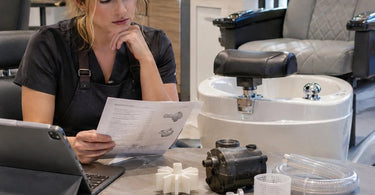
Start fresh, deliver better... and make sure your gorgeous new pedicure chair does not become the world's most expensive footrest six months from now! Purchasing professional pedicure equipment is a major investment for nail salons, day spas, and beauty businesses. While plush upholstery, massage settings, and sleek finishes certainly deserve attention, there is another purchasing consideration that can make or break your long-term satisfaction: replacement parts availability. Because nothing ruins a fully booked Saturday quite like a broken pedicure chair, a mysterious replacement component, and the realization that the manufacturer has apparently vanished into the witness protection program.
Professional pedicure equipment needs to perform consistently through repeated services, cleaning procedures, and daily operation. Components eventually wear, even on well-maintained equipment. Choosing models with accessible replacement parts, reliable manufacturer support, and straightforward maintenance requirements can help salon owners protect their investment and avoid unnecessary interruptions. Here is why parts availability should be near the top of your equipment shopping checklist.
A Beautiful Pedicure Chair Is Only as Valuable as Its Uptime
Imagine purchasing a beautiful pedicure spa chair that perfectly complements your salon. Clients love it, your technicians appreciate the comfortable seating, and the massage feature receives rave reviews. Everything is wonderful until a small component fails.
Perhaps the water pump stops circulating, a control button becomes unresponsive, or a drain fitting develops a leak. These problems do not necessarily mean the entire unit has reached the end of its useful life. In many cases, replacing the correct component can restore normal operation.
Unfortunately, a repairable problem can become a major business headache when the necessary part is unavailable. A salon might face an extended wait, expensive custom work, or the possibility of replacing equipment that otherwise remains functional.
For a business that depends on scheduled appointments, this is more than an inconvenience. It affects service capacity, staff productivity, customer satisfaction, and revenue.
The lesson? When evaluating professional pedicure equipment, look beyond how the chair performs on its first day. Consider how easily it can be maintained throughout its working life.
Replacement Parts Availability Helps Prevent Expensive Downtime
Every pedicure station represents potential revenue. If a chair or basin becomes unusable, the salon may need to move appointments, reduce booking availability, or temporarily stop offering certain services.
Suppose a station normally handles five pedicures per day at an average service price of $65. That represents $325 in daily gross service revenue associated with the station. If the equipment remains unavailable for four business days, the potential revenue exposure reaches $1,300.
That does not automatically mean the salon loses $1,300. Some appointments might be rescheduled or accommodated elsewhere, and gross revenue is not the same as profit. Nevertheless, the example demonstrates why even a relatively inexpensive replacement component can carry considerable operational importance.
A $45 part that arrives promptly may be far more valuable than a $20 part that takes three weeks to locate.
When comparing equipment, ask suppliers about typical replacement-part fulfillment times, warranty service procedures, and whether commonly needed components can be ordered individually. Availability often matters more than the lowest advertised part price.
Which Pedicure Equipment Components May Need Replacement?
Not every pedicure chair or foot spa uses the same mechanical design. Some incorporate circulating water systems, while others use removable bowls or simpler basin configurations. The parts that require maintenance or replacement depend on the equipment's construction, features, and manufacturer.
Common components worth investigating include:
- Water pumps and circulation components: Equipment with water circulation systems may eventually require servicing of pumps, associated fittings, or other manufacturer-specified components.
- Jet assemblies and removable covers: Depending on the spa design, jets, impellers, covers, or screens may need replacement due to damage or wear.
- Drain fittings and hoses: Connections, seals, and drainage components can develop problems that affect normal operation.
- Control panels and switches: Electronic controls, buttons, or remote-control components may require replacement if they fail.
- Chair upholstery and cushions: Frequent client use and exposure to approved cleaning products can gradually affect upholstery and cushioning.
- Reclining and positioning components: Some chairs contain motors, actuators, or mechanical assemblies that control positioning.
- Armrests, trays, and accessories: Frequently handled components may loosen, crack, or experience cosmetic wear.
- Footrests and technician supports: Adjustable supports and related hardware may require attention over time.
This list does not mean every component is designed for individual replacement. Some assemblies must be serviced as complete units, and certain repairs require authorized technicians. Before purchasing, confirm exactly which parts the manufacturer considers replaceable and which repairs are supported.
For related maintenance products, explore Bulbs & Replacement Parts for Spa and Salon Equipment. Compatibility must always be confirmed for the specific model, particularly because general salon replacement parts are not necessarily interchangeable with pedicure spa components.
Why Manufacturer Support Matters Just as Much as the Equipment
Two pedicure chairs can look remarkably similar while offering very different ownership experiences.
One manufacturer may provide model-specific documentation, identifiable part numbers, established service procedures, and a dependable replacement-parts ordering process. Another may offer limited documentation and uncertain support after the initial sale.
Guess which chair becomes more attractive the moment something stops working?
Before ordering, investigate the manufacturer's support infrastructure. Look for evidence that the company supplies service documentation, identifies compatible parts, and maintains a process for handling repairs.
Pure Spa Direct carries professional equipment from multiple manufacturers, including collections such as Continuum Pedicure, Whale Spa, Belava, and Meishida Spa Equipment. These collections provide starting points for comparing professional pedicure equipment styles and features. Parts policies, service arrangements, and availability should be confirmed separately for the exact model under consideration.
Remember that Pure Spa Direct is an equipment distributor, not the manufacturer of every item offered. Manufacturer warranties, replacement-part inventories, and authorized repair procedures may vary by product.
The Real Cost of Pedicure Equipment Goes Beyond Its Purchase Price
Salon equipment buyers naturally compare price tags. After all, opening a nail salon or upgrading several pedicure stations can make a business budget feel as though it just received an aggressive chemical peel.
But the initial purchase price is only one part of the financial equation.
The total cost of ownership may include equipment delivery, installation, plumbing or electrical work, routine maintenance, disinfectants, replacement components, service labor, and eventual disposal or replacement.
Consider two hypothetical pedicure chairs. Chair A costs $2,500 and Chair B costs $3,200. Chair A appears to offer an immediate $700 saving. However, if a failed component on Chair A cannot be sourced and the entire unit must be replaced prematurely, the lower initial price may prove misleading.
Conversely, Chair B is not automatically the better purchase simply because it costs more. Its long-term value depends on actual reliability, warranty coverage, repairability, parts pricing, and service availability.
Ask for the cost of commonly replaced components before purchasing. For expensive equipment, consider whether the manufacturer supplies an illustrated parts diagram or an authorized service-parts catalog.
The goal is not to assume equipment will break. The goal is to understand what happens if it does.
Replacement Components Also Affect Cleaning and Disinfection
In a professional pedicure environment, equipment maintenance is closely connected to infection prevention. Foot spa basins and certain circulating systems require careful cleaning and disinfection because debris and microorganisms can accumulate in areas that are difficult to access.
Depending on the equipment, removable jet covers, screens, footplates, or other components may be designed to permit appropriate cleaning.
If those components become damaged, cannot be securely reinstalled, or are no longer available, maintaining the equipment according to its instructions may become difficult.
That makes replacement-part access an important consideration when evaluating sanitation-friendly equipment.
Choose equipment that supports cleaning and disinfection procedures appropriate for its design. Follow the manufacturer's instructions, applicable state licensing requirements, and disinfectant label directions. Pedicure basins generally require cleaning and disinfection between clients, including the appropriate treatment of circulating components where applicable.
Disposable liners may be useful for compatible systems, but they do not automatically eliminate cleaning and disinfection obligations. Always verify the requirements for your equipment and jurisdiction.
Keep appropriate Professional Cleaners & Disinfectants available and ensure staff members understand the required procedures.
A fancy massage function is lovely. A pedicure station that can be properly maintained is essential.
Can You Repair Individual Components Instead of Replacing the Whole Chair?
Sometimes, yes. However, repairability depends on the particular model, the nature of the failure, and the manufacturer's service requirements.
A replaceable tray, approved cushion assembly, or manufacturer-specified fitting may be relatively straightforward to service. Electrical controls, motor assemblies, pumps, and plumbing components can require specialized diagnostic procedures or authorized service personnel.
Never assume a part fits because it looks similar in a photograph. Component dimensions, mounting arrangements, electrical ratings, connectors, and material specifications may differ between models and production years.
Installing an incompatible component can cause additional equipment damage, create safety concerns, or affect warranty coverage.
Before purchasing a replacement, record the equipment's manufacturer, model number, serial number, and any relevant part number. Confirm compatibility with the manufacturer or an authorized support representative.
If the equipment develops an electrical fault, leak, unusual vibration, or other potentially unsafe condition, remove it from service until it can be appropriately evaluated. Do not continue operating questionable equipment merely because appointments are on the calendar.
Ask These Questions Before Purchasing Pedicure Chairs and Spas
Smart equipment purchasing starts with asking practical questions before the delivery truck arrives. Whether you are outfitting a new nail salon or replacing an aging station, use the following checklist.
- Are replacement parts available for this exact model? Request specific information rather than a general assurance that parts are obtainable.
- Which components are sold separately? Determine whether pumps, controls, upholstery, jet components, and other assemblies are individually replaceable.
- Where do replacement parts ship from? Domestic inventory and international ordering arrangements can produce different fulfillment experiences.
- What are typical lead times? Ask about commonly requested parts and whether special-order components may take longer.
- How long does the manufacturer expect to support the model? A documented support commitment is more useful than an informal prediction.
- Is an authorized repair network available? Understand who can service the equipment in your area.
- What does the warranty actually cover? Review parts, labor, exclusions, shipping charges, and service-call responsibilities.
- Are service manuals and diagrams available? Clear documentation can help trained professionals identify parts and perform approved repairs.
- Can common wear items be stocked in advance? Determine whether keeping approved spare components makes operational sense.
- What happens if the model is discontinued? Ask whether compatible replacement assemblies or an established support process will remain available.
These questions help reveal differences that may not be obvious in equipment photographs or feature lists.
Do Different Pedicure Spa Designs Have Different Parts Requirements?
Absolutely. Pedicure equipment comes in a range of configurations, and each creates different maintenance considerations.
Traditional circulating pedicure spas may include pumps, jets, plumbing, drains, and electrical controls. Buyers should carefully investigate the availability of the manufacturer-specific components used in those systems.
Pipeless pedicure spas generally use a different circulation arrangement than traditional piped whirlpool systems. They can still contain motors, removable covers, impellers, or other serviceable components. The term pipeless does not mean maintenance-free.
Portable and removable-bowl pedicure systems may have simpler water-handling arrangements, depending on the design. However, replacement bowls, basin supports, accessories, and compatible liners may still matter.
For salon owners considering an alternative to a conventional plumbed pedicure chair, explore equipment styles and Pedicure Bowls by Noel Asmar. Verify the current specifications, available accessories, and cleaning requirements of any system before deciding whether it suits your business.
No design is universally best. The right choice depends on service volume, salon layout, sanitation procedures, staff workflow, client expectations, and maintenance resources.
How to Build a Practical Pedicure Equipment Maintenance Plan
Buying repairable equipment is an excellent first step. Creating a maintenance plan helps protect that investment.
Start by documenting each pedicure station's brand, model, serial number, purchase date, warranty terms, and authorized service contact. Keep manuals and applicable maintenance instructions accessible to the people responsible for operations.
Establish an inspection schedule based on manufacturer recommendations. Staff should report unusual sounds, leaks, damaged accessories, inconsistent controls, or changes in operation before minor problems become larger ones.
Separate daily cleaning and disinfection procedures from technical maintenance tasks. Cleaning responsibilities should be clearly assigned, while repairs involving electrical systems, plumbing, or powered assemblies should be performed by appropriately qualified personnel.
Track repairs and component replacements in a maintenance log. Over time, those records can help identify recurring problems and inform future purchasing decisions.
For high-volume salons, consider whether it is worthwhile to keep a small inventory of approved, frequently needed replacement items. Only purchase components confirmed to match the equipment, and store them according to manufacturer recommendations.
Preventive planning will not eliminate every mechanical failure, but it can make unexpected problems easier to manage.
Should You Buy Extra Replacement Parts With a New Pedicure Chair?
Sometimes purchasing spare components alongside new equipment makes financial sense, especially for businesses operating multiple identical stations.
The best candidates are reasonably priced, manufacturer-approved parts that are subject to routine wear, have known replacement intervals, or may otherwise involve inconvenient ordering delays.
However, purchasing an entire collection of spare motors and expensive electronic assemblies without understanding their expected service needs can tie up cash unnecessarily.
Ask which components the manufacturer recommends keeping on hand and whether storage conditions or shelf-life limitations apply. Some materials and electronic parts may not benefit from prolonged storage.
Also consider the business's actual ability to install or obtain service for the spare parts. A replacement assembly sitting in a cabinet is not especially helpful if the required technician is unavailable.
For salons managing multiple stations, a consistent equipment model can sometimes simplify documentation, staff training, and spare-part organization. Standardization is most beneficial when the chosen equipment has adequate manufacturer support.
Replacement Parts and the Long-Term Value of Your Salon
Professional pedicure equipment represents more than furniture. It contributes to the salon's booking capacity, service quality, and ability to deliver a consistent customer experience.
Equipment that remains maintainable can support longer useful service life and may reduce the frequency of major capital purchases. It can also make future renovations or location expansions easier to plan.
Repairability may even influence the practicality of purchasing used equipment. Before acquiring a pre-owned pedicure chair, investigate whether its model is still supported, whether parts can be obtained, and whether its condition permits safe and compliant operation.
A deeply discounted used chair is not a bargain if replacement parts are unavailable or the cost of restoring it exceeds the price of a suitable alternative.
For broader facility planning, compare professional Nail Salon Furniture and Spa and Salon Equipment & Furniture with maintenance, service access, and long-term operational needs in mind.
Do Not Forget the Everyday Supplies That Keep Services Moving
Major equipment purchases deserve careful attention, but reliable pedicure operations also depend on having the right professional supplies available.
Maintaining sufficient inventory of Pedicure Supplies, Nail Files & Buffers, Cuticle Oil, and Sugar Scrubs helps technicians deliver consistent services without unnecessary interruptions.
Salon owners can also explore Professional Nail Care Collections when organizing supplies for multiple service stations.
While consumables and mechanical replacement parts serve different purposes, both belong in a well-managed purchasing strategy. A salon needs functioning equipment and the products required to complete scheduled treatments.
There is little point in having six gorgeous pedicure chairs if your technicians have run out of the essentials needed to perform a pedicure. Beautiful furniture does not buff toenails by itself, unfortunately.
Red Flags to Watch for When Shopping for Pedicure Equipment
Some equipment listings deserve additional investigation before a salon owner commits to a purchase.
Be cautious if a seller cannot identify the equipment manufacturer, provide a complete model designation, explain warranty responsibilities, or clarify how replacement parts are obtained.
Other warning signs include unavailable service documentation, unclear repair procedures, vague promises about universal compatibility, or uncertainty about obtaining components for discontinued models.
None of these details automatically proves that equipment is poorly made. However, they indicate additional ownership risks that deserve consideration.
For major purchases, request written clarification of important support terms. Product specifications, warranty conditions, and replacement-part arrangements should be reviewed before ordering rather than after a failure occurs.
A little research at the beginning can prevent a surprising amount of frustration later.
Frequently Asked Questions About Pedicure Equipment Replacement Parts
How long should replacement parts remain available for a pedicure chair?
There is no universal availability period that applies to every manufacturer or model. Ask the manufacturer about its parts-support policy and whether it provides a documented commitment after a model is discontinued.
Are pedicure chair replacement parts interchangeable between brands?
Not necessarily. Even similar-looking components can have different dimensions, connections, materials, or electrical specifications. Confirm exact compatibility before purchasing or installing replacements.
Does a pedicure chair warranty guarantee replacement-part availability?
No. A warranty establishes specific obligations under its terms, while ongoing parts availability is a separate consideration. Review warranty coverage and the manufacturer's repair procedures independently.
Is a pipeless pedicure spa easier to maintain?
Some designs may simplify access to certain cleaning areas, but actual maintenance depends on the model. Pipeless systems can still have components that require inspection, cleaning, or replacement.
Should I purchase replacement parts before anything breaks?
Keeping a limited supply of approved wear items may be useful for a high-volume salon. Ask the manufacturer which parts are appropriate to stock, and balance their cost against expected usage and availability.
Where can professionals shop for replacement equipment and related supplies?
Pure Spa Direct offers a broad selection of professional salon and spa equipment, accessories, and replacement parts for spa and salon equipment. For pedicure-specific repairs, confirm whether the required manufacturer-approved component is available for your exact equipment model.
Make Replacement Parts Availability Part of Every Pedicure Equipment Purchase
Beautiful pedicure equipment can transform a salon's appearance, but dependable equipment is what helps keep appointments running smoothly. Before investing in a new chair, foot spa, or pedicure station, evaluate manufacturer support, repairability, replacement-part access, warranty terms, and ongoing maintenance requirements.
Those practical details can have a greater financial impact over time than an extra massage setting or a particularly glamorous upholstery color. And yes, you can absolutely care about both. Your salon deserves equipment that looks fabulous and has a sensible maintenance plan.
Explore the selection of Pedicure Chairs and Spas at Pure Spa Direct, along with professional Pedicure Supplies and related equipment accessories. Compare options carefully, confirm model-specific service support, and choose products that fit both your treatment menu and your long-term business goals.
Because the best pedicure chair is not merely the one that looks beautiful on opening day. It is the one your business can confidently maintain, service, and depend on as your salon grows.
