
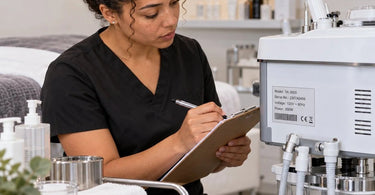
Save time and money... by doing one ridiculously simple thing before your favorite piece of spa and salon equipment decides to take an unscheduled vacation. Record its model number and serial number while it is still working perfectly. Seriously, those tiny combinations of letters and numbers can mean the difference between ordering the correct replacement part in minutes and spending an entire afternoon playing detective with a machine that refuses to cooperate. If you have ever crouched behind a treatment bed with your phone flashlight, desperately searching for a faded identification sticker while your appointment schedule falls apart, you already understand why this matters. The smartest time to gather equipment information is not when something breaks. It is the day your equipment arrives.
Professional spas, salons, nail studios, waxing businesses, massage practices, and esthetic treatment rooms depend on equipment that works consistently. A broken facial steamer, malfunctioning pedicure chair, or unreliable towel warmer can disrupt services, frustrate employees, and create unexpected expenses. Yet many businesses carefully organize their product inventory while overlooking the identifying information attached to their most valuable equipment. Fortunately, fixing that oversight does not require expensive software or a complicated management system. A few photographs, a simple spreadsheet, and a consistent recording process can make future maintenance considerably easier.
What Is the Difference Between a Model Number and a Serial Number?
Although these numbers frequently appear together on the same equipment label, they serve different purposes. Understanding the distinction makes it easier to communicate with manufacturers, equipment technicians, and replacement parts suppliers.
Model number: The model number identifies a particular equipment design, configuration, or product version. Multiple machines may share the same model number because they belong to the same product family. Manufacturers use this information to identify compatible components, operating instructions, specifications, and service documentation.
Serial number: A serial number generally identifies an individual machine or unit. Depending on the manufacturer, it may help establish production details, determine whether particular components were used during manufacturing, confirm warranty eligibility, or identify equipment affected by a service notice.
For example, imagine your spa owns three identical-looking facial steamers. They might share a model number but have different serial numbers. Even machines that look identical can sometimes contain different internal components if a manufacturer changes a design during production.
That is why recording both numbers is important. The model number helps identify what equipment you have, while the serial number helps identify the specific unit requiring attention.
Why Waiting Until Equipment Breaks Creates Unnecessary Problems
Equipment rarely chooses a convenient moment to stop working. The facial steamer does not consult your appointment calendar before developing a problem. The pedicure chair does not politely announce that it intends to malfunction after your final client leaves. And your towel warmer certainly does not care that Saturday is your busiest day.
When a machine stops working, your immediate priorities become protecting client safety, preventing additional damage, and restoring normal operations. Searching for identification numbers adds another unnecessary task during an already stressful situation.
Depending on the equipment, the manufacturer's identification plate might be positioned beneath a base, behind a removable cover, near a power connection, or along the underside of the machine. Those locations can become difficult to access after equipment has been installed against a wall or surrounded by furniture.
Labels may also become worn, obscured by residue, or damaged over time. Some information becomes harder to read after years of cleaning and daily handling.
Recording equipment information when the machine is new eliminates much of this uncertainty. Instead of crawling behind a heavy chair during a busy workday, your team can open an equipment record and immediately retrieve the details needed for a service inquiry.
Correct Numbers Help You Find the Right Replacement Parts
One of the most valuable reasons to record model and serial numbers is replacement part compatibility. Professional equipment can contain components that vary significantly between manufacturers, models, and production versions.
Consider the variety of machines used throughout a professional beauty business:
- Professional Wax Warmers for Salons & Spas may require model-specific heating elements, thermostats, inserts, or temperature controls.
- Pedicure Chairs and Spas may contain specialized pumps, plumbing components, controls, or electrical assemblies.
- Towel Steamers may require particular heating components, switches, seals, or other manufacturer-approved parts.
- Magnifying Lights may use different lamp assemblies, power supplies, mounting components, or replacement accessories.
- Advanced Spa Equipment may incorporate proprietary handpieces, circuit boards, filters, or specialized accessories.
- Massage Tables and Chairs may need compatible controls, motors, cables, or mechanical components.
A replacement component that looks similar is not necessarily compatible. Even minor differences in voltage, electrical connections, dimensions, or operating specifications can create performance or safety problems.
Having the exact model and serial number available helps the manufacturer or authorized service provider verify compatibility before a part is ordered. It can also reduce the likelihood of purchasing an incorrect component, waiting for another shipment, or extending equipment downtime.
When replacement components are needed, explore Bulbs & Replacement Parts for Spa and Salon Equipment while confirming suitability for your specific machine. Always follow manufacturer instructions and use qualified service professionals for repairs that require specialized technical knowledge.
Your Equipment Identification Record Can Make Warranty Claims Easier
Picture this: Your expensive new treatment equipment develops a problem, and you believe it may still be covered by the manufacturer's warranty. You contact customer support, explain the issue, and are immediately asked for the model number, serial number, and proof of purchase.
Suddenly, everyone is searching through old emails, purchase folders, and paperwork. Someone remembers ordering the machine last spring. Someone else insists it arrived closer to summer. Meanwhile, the machine remains unusable.
Warranty requirements vary by manufacturer, but many manufacturers request identifying information and dated proof of purchase before evaluating coverage or arranging service. Some also use serial numbers to verify production details or determine whether specific warranty conditions apply.
A complete equipment record makes this process easier because the relevant information is already organized.
For every significant equipment purchase, retain the model number, serial number, purchase date, invoice or receipt, warranty documentation, and available manufacturer contact information. If the product requires registration, complete that process according to the manufacturer's instructions rather than assuming that saving the serial number automatically registers the warranty.
Remember that maintaining records does not guarantee coverage. Warranty eligibility depends on the manufacturer's actual terms, exclusions, purchase documentation, and applicable conditions. However, having accurate information available can eliminate avoidable delays when requesting assistance.
Where Can You Find Model and Serial Numbers on Spa and Salon Equipment?
Equipment identification labels are not always positioned where you expect them. Different manufacturers place information in different locations, and some products may have separate labels for the main unit and individual attachments.
Common locations include the rear panel, underside of the base, side of the housing, manufacturer's specification plate, or area near the power cord connection. Some equipment displays the information on a permanent metal plate, while other products use printed adhesive labels.
For professional LED lamps, identification information may appear underneath the base or near the electrical specifications. For microcurrent machines and other esthetic devices, it may be located on the main control unit rather than the treatment handpiece. For motorized furniture, identification labels may appear underneath the frame or near the control mechanism.
Always consult the manufacturer's manual if the correct location is unclear. Never remove protective panels, open electrical housings, or reach into moving mechanisms simply to locate a serial number. Disconnect and secure equipment according to the manufacturer's instructions before checking accessible areas, and use a qualified technician when identification requires disassembly.
Once the label is located, photograph it clearly. Take a second photograph showing the entire machine so the label can be associated with the correct piece of equipment.
The Equipment Information Every Spa and Salon Should Record
A useful equipment inventory should contain more than a collection of serial numbers. The goal is to create a practical reference that helps owners, managers, technicians, and authorized staff identify equipment quickly.
For each machine, record the following information:
- Equipment name: A clear description, such as Facial Steamer - Treatment Room 2.
- Manufacturer or brand: The company responsible for manufacturing the equipment.
- Model number: The exact identifier printed on the machine or manufacturer documentation.
- Serial number: The complete serial number, including letters, zeros, hyphens, and any other characters.
- Purchase date: The date of purchase or another date specified in the warranty terms.
- Purchase source: The distributor, retailer, or supplier from which the equipment was obtained.
- Invoice number: A reference that makes the original purchase easier to locate.
- Warranty information: Coverage terms, expiration details when known, and registration confirmation if applicable.
- Equipment location: The treatment room, workstation, or department where the machine is installed.
- Service contact: Manufacturer support information or the authorized repair provider.
- Maintenance history: Dates of inspections, professional servicing, repairs, and component replacements.
- Photographs: Clear images of the identification label and the complete equipment unit.
For complicated machines, it may also help to record software versions, accessory model numbers, installation dates, and special electrical or plumbing requirements. These additional details should be included when relevant to the specific equipment and manufacturer.
Do not worry about making the system elaborate. A clean spreadsheet with accurate information is more useful than an impressive-looking database nobody remembers to update.
How to Build a Simple Spa Equipment Inventory in One Afternoon
Creating an equipment identification system does not have to become a gigantic administrative project. The easiest approach is to divide the business into manageable sections and document equipment room by room.
Step 1: Start with equipment that would interrupt services if it failed. Prioritize machines that are essential to booked appointments, difficult to replace quickly, expensive to repair, or especially important for daily operations. This might include hydrodermabrasion equipment, high frequency machines, electric treatment beds, pedicure spas, and essential salon appliances.
Step 2: Identify each machine individually. Give every major unit an internal asset name or number. If you own four identical wax warmers, distinguish them as Wax Warmer 01, Wax Warmer 02, Wax Warmer 03, and Wax Warmer 04 rather than listing all four under one vague description.
Step 3: Photograph identification labels. Capture a sharp, readable image of the manufacturer's label. Check that letters and numbers are legible before moving on. A photograph of a blurry sticker is not much help when you need it later.
Step 4: Enter the details into a shared inventory. Use a spreadsheet, an equipment management platform, or another secure recordkeeping system accessible to appropriate staff. Enter numbers exactly as printed and preserve leading zeros.
Step 5: Attach purchase and warranty documentation. Save electronic receipts, manuals, registration confirmations, and service instructions alongside the corresponding equipment records.
Step 6: Create a backup. Keep a secure backup of the inventory so a lost computer, damaged phone, or employee departure does not erase your equipment history.
Step 7: Assign responsibility. Choose a manager or designated team member to update records whenever equipment is purchased, relocated, repaired, replaced, or retired.
Once the initial inventory is finished, maintaining it becomes much easier. New equipment simply gets documented during receiving and installation instead of joining the mysterious collection of machines whose paperwork disappeared three years ago.
Why Equipment Photographs Are Just as Important as Written Numbers
Typing numbers into a spreadsheet is useful, but photographs provide an extra layer of protection against recording mistakes.
Characters can look remarkably similar on small equipment labels. The letter O can resemble the number zero. The letter I may look like the number one. Certain fonts make B and 8 surprisingly difficult to distinguish. One incorrect character can complicate a parts search or warranty inquiry.
Photographs allow staff to compare the written entry with the original label before contacting support. They can also help a service provider identify the equipment's design and exterior configuration.
For larger machines, photograph the equipment from the front and side, along with accessible connection panels when appropriate. Avoid opening electrical compartments or interfering with safety guards.
Store images with descriptive filenames that connect them to the corresponding inventory record. For example, TreatmentRoom2-FacialSteamer-SerialLabel.jpg is far more useful than IMG_4837.jpg.
If multiple people are responsible for equipment management, clear labeling prevents photographs from being confused or attached to the wrong machine.
How Serial Numbers Can Improve Preventive Maintenance
Serial numbers are not only useful when something breaks. They can also support ongoing maintenance planning.
Professional equipment frequently requires periodic cleaning, inspections, calibration, filter replacement, or other manufacturer-specified servicing. The correct maintenance schedule depends on the machine, its usage, and the manufacturer's instructions.
An equipment inventory can connect these tasks to individual units, especially when a business owns multiple machines of the same model.
Imagine two identical hot stone warmers. One has been in daily use for several years, while the other was purchased recently as a backup. Recording their individual identification numbers and service histories helps staff distinguish the machines and avoid confusing maintenance records.
The same principle applies to ultrasonic facial machines, professional sunless tanning equipment, and light therapy devices.
A practical maintenance log might include the date of service, technician or employee responsible, observed symptoms, approved work completed, replacement components installed, and the next scheduled inspection.
This creates a more useful picture of equipment performance over time. Instead of relying on someone's memory of whether a machine was repaired last winter or the winter before, your team has an actual record.
Equipment Records Help Businesses Make Better Repair-or-Replace Decisions
Eventually, almost every spa or salon owner faces a familiar question: Should we repair this machine again, or is it finally time to replace it?
Without organized maintenance records, that decision often relies on guesswork. A machine may seem like a reliable workhorse until someone adds up the repeated repair expenses, service interruptions, and replacement parts ordered over the previous year.
Tracking each machine by its unique identifier allows managers to review the history of that exact unit rather than mixing its costs with those of identical equipment.
When evaluating repair versus replacement, consider the expected repair cost, equipment age, remaining useful life, availability of manufacturer-approved parts, service downtime, warranty coverage, and operational importance.
Safety matters too. Equipment with damaged wiring, recurring overheating, malfunctioning protective features, or other potentially hazardous conditions should be removed from service and evaluated by an appropriately qualified professional. A lower repair estimate does not justify returning unsafe equipment to client use.
For businesses evaluating replacements, categories such as Luxury Spa Furniture, Professional Salon Equipment, and Nail Salon Furniture Essentials can help organize the search for suitable professional equipment.
The important advantage is having enough information to make a considered purchasing decision rather than replacing something impulsively during an equipment emergency.
What Happens When You Own Multiple Locations?
Equipment tracking becomes even more valuable when a spa, salon, or beauty business expands beyond one location.
Without individual asset records, machines may be moved between locations without documentation. A treatment bed purchased for one studio might eventually end up in another. A backup steamer may be transferred to a newly opened treatment room. Months later, nobody remembers which machine belongs to which purchase record.
A centralized inventory provides a consistent system for every location. Each unit should have a unique internal asset identifier, an assigned location, and its manufacturer identification information.
When equipment moves, update the location field rather than creating an entirely new equipment record. That preserves its history and prevents duplicate entries.
Multi-location operators can also compare repair patterns across similar machines, evaluate equipment replacement needs, and coordinate service requests more efficiently.
For managers responsible for numerous treatment rooms, this simple administrative habit can eliminate a surprising amount of confusion.
Make Equipment Documentation Part of Your Receiving Checklist
The easiest way to ensure model and serial numbers are recorded consistently is to make documentation part of every equipment delivery.
Before putting a new machine into regular service, establish a receiving process that includes checking the delivery for visible damage, confirming the item received matches the order, locating its identification label, and recording the relevant information.
Photograph the equipment and save the invoice and supplied documentation. Review installation, operating, cleaning, and maintenance instructions. If the manufacturer requires product registration, complete that step as directed.
For equipment requiring professional installation, testing, calibration, or plumbing and electrical connections, follow the manufacturer's requirements and use appropriately qualified personnel.
This checklist works for everything from a relatively simple salon wax warmer to a sophisticated radio frequency machine.
Consider including the equipment documentation step in new employee onboarding for managers and lead technicians. When everyone follows the same process, the system stays organized even as staff responsibilities change.
Common Equipment Tracking Mistakes to Avoid
Even a well-intentioned equipment inventory can become less useful if a few basic details are overlooked.
Recording only the brand: Knowing the manufacturer does not necessarily identify the exact equipment configuration. Always capture the model and serial numbers when provided.
Confusing the product SKU with the manufacturer's model number: A retailer's stock number may differ from the manufacturer's equipment identifier. Record both separately when useful.
Saving only one photograph: A close-up of an identification plate may be difficult to match with the correct machine later. Include a photograph of the complete unit.
Keeping everything on one employee's phone: Equipment records should remain available to authorized business personnel, even when someone changes roles or leaves the company.
Forgetting to update locations: Moving equipment without updating its record can lead to confusion during inspections and repair requests.
Throwing away purchase documentation: A serial number does not always replace the need for an original receipt or invoice.
Assuming similar equipment uses identical parts: Manufacturers may revise components between production runs. Confirm part compatibility using the complete equipment information.
Recording numbers only after a breakdown: This defeats the entire purpose of the system. Do it while the equipment is accessible and operating normally.
Can Equipment Serial Numbers Help With Insurance and Asset Management?
Yes. Accurate identifying information can be useful for broader business administration, including asset inventories, ownership documentation, insurance inquiries, and equipment replacement planning.
If equipment is damaged, lost, or stolen, a detailed inventory can help establish which specific items were involved. Photographs, serial numbers, purchase invoices, and recorded equipment locations may provide useful supporting information when communicating with an insurance provider.
However, documentation alone does not guarantee that an insurance claim will be approved or that a particular loss is covered. Coverage depends on the actual insurance policy and circumstances.
Equipment records can also assist with internal financial planning by helping distinguish individual business assets and track acquisition and replacement history.
For accounting and tax treatment, consult a qualified professional about appropriate records, depreciation, and business-specific requirements.
A Five-Minute Monthly Equipment Check Can Prevent Future Confusion
Once your inventory exists, keeping it useful requires only a manageable routine.
During a regular equipment review, confirm that machines are still assigned to the correct rooms, recently purchased equipment has been entered, and completed maintenance or repairs have been documented.
Review outstanding service requests and upcoming manufacturer-recommended maintenance. Confirm that important records remain accessible and that backup copies are current.
Pay particular attention to essential equipment that directly affects revenue-producing services. A business heavily dependent on specialized facial treatments may prioritize the maintenance records for its microdermabrasion machines, while a busy nail salon may focus on its pedicure spas and ventilation-related equipment.
The monthly administrative review complements, rather than replaces, the daily safety checks and maintenance activities required by manufacturers.
Not every equipment problem can be prevented. But the confusion surrounding equipment identification can be dramatically reduced with consistent documentation.
The Best Time to Record Equipment Numbers Is Before You Need Them
Your spa or salon equipment has an important job: supporting professional services, client comfort, and dependable business operations. A small amount of organization behind the scenes helps protect that investment.
Recording model numbers and serial numbers before equipment breaks makes it easier to request technical support, verify replacement part compatibility, organize warranty information, maintain accurate service histories, and plan future purchases.
It also gives your team a practical advantage during an unexpected breakdown. Instead of hunting for an unreadable sticker beneath a machine, you can provide accurate identification information and move directly toward the next appropriate service step.
Whether your business relies on Facial Steamers, Professional Wax Warmers, Pedicure Chairs, or Professional Massage Tables, every important piece of equipment deserves a complete identification record.
If you are reviewing your existing setup or planning equipment purchases, explore the professional equipment and replacement parts available through Pure Spa Direct. As a professional distributor, Pure Spa Direct offers equipment and supplies from multiple manufacturers, making accurate brand, model, and serial number documentation especially helpful when identifying the appropriate product or manufacturer support channel.
So give your future self a little gift. Grab your phone, find those equipment labels, and start recording. Your future self - the one with a fully booked schedule and a machine that suddenly refuses to turn on - will be extremely grateful.
