
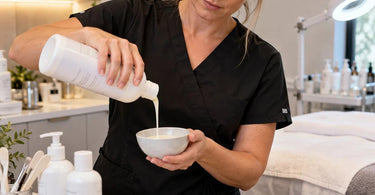
Maximize your potential with smarter product management, more accurate service costing, and a little less creative pouring at the treatment station! If your spa or salon professionals are free-pouring massage oils, lotions, and creams, facial cleansers, body scrubs, or other professional products without measuring, your service costs may be telling you a very entertaining work of fiction. One therapist uses three generous pumps, another pours enough oil to moisturize an entire neighborhood, and somehow both treatments appear to cost exactly the same on your spreadsheet. Sound familiar? The problem is not necessarily that your team is intentionally wasting products. It is that inconsistent dispensing makes it nearly impossible to know what each service actually costs, and those little differences can quietly eat into your profitability.
Professional spa and salon owners spend considerable time developing treatment menus, setting prices, selecting premium products, and creating memorable client experiences. Yet one of the most important profitability variables often receives surprisingly little attention: the actual quantity of product consumed during each appointment. Understanding why service costing gets inaccurate when staff free-pour products can help you improve inventory control, protect your margins, and establish more consistent treatment procedures without turning your beautiful spa into a chemistry laboratory.
What Is Service Costing, and Why Does Accurate Product Usage Matter?
Service costing is the process of calculating how much your business spends to deliver a particular treatment. Depending on the service, those expenses may include professional products, disposable supplies, employee compensation, laundry, equipment expenses, and allocated overhead.
For many treatments, professional backbar products represent an important variable expense. Backbar refers to the products your professionals use while performing services rather than the retail products sold to clients for home use.
Consider a 60-minute massage. The therapist may use massage oil, lotion, aromatherapy products, and disposable treatment supplies. A facial might involve cleanser, exfoliant, toner, serum, treatment mask, moisturizer, and finishing products. A body treatment could require significant amounts of scrub, massage cream, or body mask.
To calculate accurate product costs, you need to know two things: how much each product costs per measurable unit and how much of that product is consumed during the service.
The basic formula is straightforward: product cost per service equals product cost per unit multiplied by the quantity used. Calculate each product separately and add those amounts together to determine total product expense.
Unfortunately, the formula becomes much less useful when the quantity used is simply an educated guess.
Free-Pouring Turns Predictable Expenses Into Guesswork
Free-pouring happens whenever a professional dispenses product directly from its container without consistently measuring the amount. It might be a quick squeeze of facial cleanser, a generous stream of massage oil, an extra scoop of body scrub, or a little more conditioner than the service actually requires.
The difficulty is that everyone has a different interpretation of what constitutes a reasonable amount.
One esthetician may dispense a nickel-sized portion of cleanser. Another may use twice as much because the product feels luxurious. A massage therapist might pour additional oil whenever their hands begin feeling dry, while another achieves the same glide with less product.
None of these decisions necessarily indicates poor technique. Client needs, treatment area, product formulation, and service duration can legitimately change consumption. However, without a consistent measurement system, managers cannot easily distinguish justified additional usage from avoidable overconsumption.
That uncertainty makes accurate budgeting, inventory forecasting, and service profitability analysis significantly more difficult.
The Simple Math Behind a Surprisingly Expensive Extra Pour
Imagine that your spa purchases a professional massage oil for $64 per 32-fluid-ounce container. That works out to $2 per fluid ounce.
Your treatment protocol estimates that each massage requires 1.5 fluid ounces, creating an expected oil cost of $3 per appointment.
Now suppose your therapists actually average 2.25 fluid ounces because they are free-pouring from the bottle. The actual oil cost becomes $4.50 per service.
That extra $1.50 might seem harmless. After all, it is hardly enough to cause a dramatic confrontation in the break room.
But consider the larger picture:
- Expected massage oil cost per treatment: $3.00.
- Actual massage oil cost per treatment: $4.50.
- Additional product expense per treatment: $1.50.
- Monthly volume: 400 massages.
- Additional monthly product expense: $600.
- Additional annual product expense at that volume: $7,200.
That is $7,200 in additional annual massage oil expense alone, assuming consistent service volume and pricing. It does not include extra lotion, aromatherapy, scrub, or other supplies that may also be overused.
The example is hypothetical, and actual costs vary by treatment and product. Nevertheless, it demonstrates why small dispensing differences can become meaningful expenses when multiplied across hundreds or thousands of appointments.
Why Free-Pouring Makes Your Service Profit Margins Misleading
Suppose your treatment menu lists a facial at $125. Your costing worksheet estimates $12 in professional products and disposable supplies. Based on that estimate, you make decisions about labor compensation, promotions, package pricing, and expected contribution margins.
But what happens if the treatment actually consumes $17 worth of products?
Your worksheet understates direct product expenses by $5 per appointment. That difference reduces the money remaining to cover labor, overhead, and profit.
The business might continue reporting healthy-looking service margins while ordering replacement products more frequently than expected.
This creates a particularly frustrating situation for owners: the appointment calendar looks busy, service revenue looks strong, and yet operating profit does not seem to match the effort required to generate it.
Inaccurate product costing can contribute to that disconnect.
It also makes pricing decisions unreliable. A manager may assume a treatment is highly profitable and promote it aggressively, not realizing that its actual consumption costs are substantially higher than the original estimate.
Different Professionals Can Create Different Costs for the Same Service
One of the biggest challenges with uncontrolled product dispensing is variation between employees.
Imagine that three estheticians perform the same signature facial using identical professional skincare products.
The first follows the recommended product quantities closely. The second regularly dispenses additional cleanser and mask because she prefers a thicker application. The third makes larger portions in advance and discards whatever remains after each appointment.
All three charge the client the same service price. All three complete the same advertised treatment. Yet their actual product costs differ.
This inconsistency can affect individual service profitability, inventory consumption, treatment standardization, and even the reliability of employee performance reports.
Importantly, differences are not always caused by carelessness. Professionals may have received different training, worked with other product systems, or developed habits that made sense in previous workplaces.
The solution is not to criticize team members for every extra drop. Instead, establish practical product usage guidelines and provide the tools needed to follow them.
Massage Oils and Lotions Are Particularly Easy to Overuse
Massage products deserve special attention because they are frequently dispensed during an active treatment, when the therapist is focused on pressure, glide, client comfort, and maintaining a relaxing experience.
Interrupting a massage to measure every refill would be awkward. Nobody books a Swedish massage hoping to hear someone announce that the next portion contains precisely 12 milliliters.
Fortunately, measuring products does not need to interfere with service flow.
Many professional massage oils, lotions, and creams can be dispensed through suitable pump bottles or prepared in measured portions before the appointment.
For example, a spa might determine that its standard 60-minute massage usually requires a specific starting quantity of oil. The therapist receives that measured amount and has access to additional product when genuinely needed.
This method encourages consistency without ignoring differences in body size, skin condition, massage modality, treatment duration, or therapist technique.
The goal is efficient application, not forcing every client into an identical product allowance.
Facial Treatments Can Hide Waste in Small, Expensive Portions
Facial product waste may be less visually dramatic than an overflowing bottle of massage oil, but it can be especially costly when concentrated professional formulas are involved.
A small amount of premium serum may represent a meaningful portion of the product expense for an entire facial.
Estheticians working with advanced facial treatment products often dispense multiple formulas during a single appointment. If each step uses slightly more product than necessary, the combined difference can become significant.
Consider a facial protocol that includes cleanser, exfoliating product, massage medium, treatment mask, serum, and moisturizer. Each formula may appear inexpensive on its own when measured per treatment. But multiplying excess usage across six products and a busy appointment schedule changes the economics.
Another source of waste occurs when an esthetician prepares too much product in a treatment bowl. Once a product has been portioned into a client-use container or exposed to treatment conditions, returning leftovers to the original stock container may create a contamination risk.
Appropriately sized mixing bowls, hygienic dispensing methods, and realistic protocol quantities help reduce unnecessary leftovers while supporting safe treatment practices.
Body Scrubs and Wraps Create Their Own Portion-Control Challenges
Professional body treatments often use larger product quantities than facial services, which means inconsistent application can produce noticeable differences in cost.
For example, a technician applying a sugar scrub might use a generous handful for each body area. Another technician might achieve the desired exfoliation using smaller, evenly distributed portions.
With salt scrubs, body masks, and moisturizing treatments, variations in scoop size, treatment area, and leftover product can all influence actual cost per appointment.
These services benefit from defined starting quantities and clearly documented guidelines for when additional product is appropriate.
Staff should also use clean, suitable dispensing tools and follow manufacturer instructions concerning product handling, treatment suitability, and sanitation.
Consistency should support both product efficiency and professional treatment quality.
Hair Color and Chemical Services Need More Than an Eyeballed Bowl
Free-pouring is not limited to spa treatment rooms. Hair salons face similar challenges when stylists dispense color, developer, lightener, and conditioning treatments without accurately measuring the quantities used.
In professional hair color services, inaccurate measuring can affect more than profitability. Many chemical formulas require specific mixing ratios to produce intended performance and follow manufacturer directions.
Using too much product may increase costs and create leftover mixture that must be discarded. Using incorrect proportions can compromise the service itself.
Professional stylists should follow the product manufacturer's mixing instructions and use appropriate scales or graduated measuring tools where specified.
Salon managers can then calculate the expense of each formula based on the actual quantities of color, developer, lightener, and other products dispensed.
This is especially valuable for services where product requirements vary considerably with hair length, density, previous color history, or the desired result.
Rather than assigning one unrealistic product quantity to every appointment, create baseline costs and record justified variations.
Inventory Shrinkage Becomes Harder to Explain
Product costing and inventory control are closely connected.
If your service records assume that a liter of treatment lotion provides a certain number of appointments, but employees consistently use more than the budgeted quantity, your inventory will disappear faster than expected.
The purchasing manager may reorder supplies early without understanding why the original stock estimate was inaccurate.
Over time, that discrepancy can create several operational problems:
- Unexpected backbar shortages during busy appointment periods.
- More frequent purchasing and unnecessary rush orders.
- Difficulty forecasting monthly supply requirements.
- Inaccurate inventory counts and service-level consumption reports.
- Confusion about whether missing inventory reflects waste, spills, damage, recording errors, or other causes.
- Less reliable budgeting for seasonal promotions and treatment packages.
Separating retail inventory from professional backbar inventory can make these patterns easier to identify.
It is also useful to record tester consumption, employee training usage, spills, expired products, and other legitimate inventory adjustments. Not every missing ounce was used in a paying service.
Accurate records create a clearer picture of where products are actually going.
How to Calculate the True Product Cost of a Treatment
Before introducing new dispensing procedures, establish a reliable baseline for your most frequently performed treatments.
Step 1: Identify every product used. List the professional formulas and disposable supplies required for the service. Include items that are easy to overlook, such as finishing products, treatment additives, wipes, or single-use applicators.
Step 2: Determine the actual cost per unit. Divide the net acquisition cost of each product by its usable quantity. For example, a $48 bottle containing 16 fluid ounces costs $3 per fluid ounce before accounting for any unusable remainder or loss.
Step 3: Measure typical consumption. Observe several representative appointments and record product quantities using suitable measuring methods. Measurements should reflect actual treatment requirements rather than arbitrary guesses.
Step 4: Calculate the cost of each product used. Multiply the measured quantity by the product's cost per corresponding unit. Be consistent about ounces, milliliters, grams, and other units. Fluid ounces measure volume, while ounces used for weight measure mass; they are not automatically interchangeable.
Step 5: Add product and disposable costs. This produces your direct supply cost for the treatment. Add labor and appropriately allocated overhead separately when calculating the full cost of delivering the service.
Step 6: Compare actual usage with the treatment standard. Identify meaningful differences and investigate why they occur before changing service prices or criticizing employee performance.
Repeat this process when suppliers change prices, product formulations change, treatment protocols evolve, or your service menu is updated.
Simple Tools That Make Portion Control Easier
You do not need expensive automation to improve product consistency. In many spas and salons, basic dispensing tools can make a meaningful difference.
Consider using bottles and jars that are compatible with your professional products and equipped with appropriate dispensing systems.
Depending on the product and service, practical options may include measured pumps, graduated containers, calibrated scoops, digital scales, and pre-portioned treatment containers.
For example, if a verified pump dispenses approximately 5 milliliters per full stroke, four full pumps would provide approximately 20 milliliters. However, pump output should be tested with the actual product because viscosity, dispenser design, incomplete strokes, and priming can affect the quantity delivered.
Product labels, container compatibility, sanitation requirements, and manufacturer instructions should guide the choice of dispensing tools.
Never transfer a professional chemical into an unlabeled container or use a dispensing method that conflicts with its safety instructions.
For treatments involving potentially reactive chemical mixtures, follow all applicable manufacturer procedures rather than substituting convenient but unsuitable measuring equipment.
These simple precautions protect both accuracy and professional standards.
Create Treatment Protocols That Specify Realistic Quantities
A treatment protocol should describe more than the order in which products are applied. It should also document reasonable starting quantities for routine steps.
For example, a professional facial protocol might identify the recommended amount of cleanser, exfoliant, treatment mask, serum, and moisturizer for an average appointment.
A massage protocol might define a starting quantity of massage medium for each service duration, with allowances for client needs and treatment modifications.
A body treatment protocol might establish separate portions for arms, legs, back, and other treatment areas.
These guidelines give professionals a shared starting point while allowing appropriate clinical or technical judgment within their scope of practice.
They also make onboarding new employees easier. Rather than learning product usage exclusively through observation or personal preference, new team members have written standards they can practice and understand.
Training should emphasize that measured dispensing is a quality and business management tool, not an accusation that employees cannot be trusted.
Train Your Team Without Becoming the Product Police
Few professionals enjoy being watched as though every pump of lotion is coming directly out of the owner's vacation fund.
Fortunately, successful portion control depends more on clear communication than constant supervision.
Explain why product measurements matter. Show employees how consistent usage supports sustainable service pricing, reliable inventory, professional treatment standards, and the business's long-term stability.
Demonstrate dispensing methods during training sessions and invite employees to identify situations where the recommended amounts may be unrealistic.
Your most experienced estheticians, massage therapists, nail professionals, and stylists may have valuable insights into how product formulation and treatment technique affect consumption.
Encourage practical feedback. If a mask consistently requires more product than the written protocol allows, the protocol may need adjustment. If a massage lotion performs better after a technique change, share that discovery with the rest of the team.
When employees understand the purpose behind measurement and participate in establishing standards, consistent dispensing becomes a professional habit instead of an irritating rule.
How to Audit Product Usage Without Slowing Down Appointments
Once you establish baseline quantities, periodically compare expected inventory consumption with actual results.
Begin by selecting a frequently used backbar product. Record opening inventory, purchases, documented transfers, and closing inventory during a defined period.
Calculate actual consumption by adding opening inventory to purchases and transfers received, then subtracting closing inventory and any transfers out. Account separately for documented spills, training, testers, and other non-service uses.
Next, compare service-related consumption with the quantities expected from completed appointments.
For example, if your records show 100 massages and the established standard is 1.5 fluid ounces per service, the expected treatment usage is 150 fluid ounces.
If the verified service-related consumption is 190 fluid ounces, you have a 40-fluid-ounce difference to investigate.
That does not automatically mean someone wasted the entire amount. Longer appointments, different techniques, unusual client needs, measurement errors, and undocumented product transfers can also explain discrepancies.
The purpose of an audit is to identify the cause, improve records, and refine procedures where necessary.
Many salons can begin with a simple spreadsheet before adopting more advanced inventory management software.
Should You Charge More When a Service Requires Extra Product?
Not every treatment can or should use an identical quantity of supplies.
Long hair may require additional color. A larger treatment area may need more body product. A specialized facial may incorporate extra professional formulas. Extended massage appointments naturally consume more product than shorter services.
The key is recognizing these differences and incorporating them into your pricing strategy.
Some businesses use service tiers based on appointment duration, treatment complexity, hair length, product consumption, or clearly defined add-ons.
Others build a reasonable range of product usage into their standard prices.
Either approach can work when costs are documented, pricing is transparent, and clients understand applicable charges before the service begins.
Avoid surprising clients with unexplained product fees after an appointment. Consistent communication is just as important as consistent dispensing.
Also remember that higher product consumption does not always justify a price increase. Sometimes improved dispensing technique, better treatment planning, or a more suitable product can solve the problem without changing the client's bill.
Buying in Bulk Helps, but It Does Not Fix Free-Pouring
Purchasing professional products in larger sizes can sometimes reduce their cost per ounce or milliliter, making bulk purchasing attractive for busy spas and salons.
However, a lower acquisition cost does not automatically create better profitability if employees continue dispensing excessive amounts.
Imagine replacing smaller massage oil containers with larger professional backbar sizes. Your purchase cost per ounce decreases, but therapists begin pouring more generously because the larger supply appears plentiful.
Some or all of the anticipated savings may disappear.
The same principle applies to waxing products, professional shampoos, body treatments, and other frequently replenished supplies.
For services using waxing supplies for professionals, for instance, product usage depends on factors such as treatment area, wax type, application thickness, technique, and unavoidable material remaining in equipment.
More economical purchasing should be paired with realistic consumption standards, appropriate equipment, and periodic inventory reviews.
At Pure Spa Direct, we supply professional spas, salons, massage businesses, barbershops, and beauty professionals with a broad selection of wholesale products and equipment. Our role as a distributor is to help professionals find suitable supplies for their services, including products and practical tools that support more organized backbar operations.
Five Practical Changes You Can Make This Week
Improving product usage accuracy does not require rebuilding your entire business operation overnight. Start with a few manageable changes.
- Choose three high-volume services. Focus on treatments performed frequently enough that small consumption differences could have a meaningful financial impact.
- Measure real product usage. Record the actual quantities used during multiple representative appointments rather than relying entirely on existing estimates.
- Introduce suitable dispensing tools. Select pumps, portion containers, scoops, or scales that work safely with the products and do not interrupt treatment quality.
- Update written service protocols. Establish practical starting quantities, document exceptions, and teach the same procedures to everyone performing the service.
- Review results after several weeks. Compare supply consumption, service volume, employee feedback, and treatment outcomes to determine whether the changes are helping.
Keep the process collaborative and manageable. A system that is easy for employees to follow is much more likely to remain effective than one requiring complicated measurements during every minute of a busy appointment.
Common Questions About Product Portion Control
Does free-pouring always mean a technician is wasting product?
No. Free-pouring means the amount dispensed is not consistently measured. Additional usage may be appropriate for certain clients, treatments, or techniques. The concern is the lack of reliable records and the inability to separate necessary consumption from preventable excess.
Can I calculate service costs using the amount recommended by the manufacturer?
Manufacturer guidelines are a valuable starting point, but actual usage should be verified during real services. Treatment requirements, dispensing equipment, and professional technique may affect the quantity consumed. Always follow manufacturer safety and mixing instructions.
Should every employee use exactly the same amount?
Not necessarily. Standard portions provide consistency, but legitimate client needs and service modifications may require adjustments. Documenting those exceptions is more useful than enforcing an inflexible allowance.
How often should I review my backbar costs?
Review high-volume and expensive products regularly, investigate unusual inventory differences promptly, and update costing calculations whenever purchase prices or protocols change. A more comprehensive periodic review can identify longer-term trends.
Will portion control make treatments feel less luxurious?
It should not. Proper portion control aims to use the amount needed to deliver the intended professional result. A luxurious service is defined by quality, comfort, expertise, and thoughtful attention, not by how much product gets poured into a bowl.
Accurate Service Costing Starts With Every Drop
Understanding why service costing gets inaccurate when staff free-pour products is an important step toward running a more predictable, profitable spa or salon. Without reliable measurements, product expenses become estimates, inventory forecasts become less dependable, and service margins can appear healthier than they really are.
The good news is that improving accuracy often requires practical changes rather than complicated systems. Measured dispensing, clearly defined treatment protocols, appropriate staff training, and regular inventory reviews can bring much-needed clarity to your backbar expenses.
Explore professional spa essentials, applicators and spatulas, dispensing bottles and jars, and other treatment supplies at Pure Spa Direct to help create organized, efficient workstations for your team.
Because every professional wants to deliver an amazing treatment, every client deserves consistent quality, and every business owner deserves to know where the money is going. Your products should be working hard for your business, not disappearing into the treatment bowl like they have somewhere more exciting to be!
