
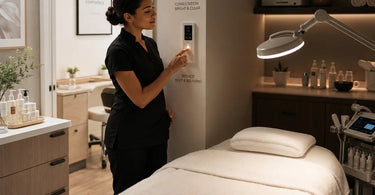
Achieve more with less effort—starting with the flip of a switch. Let's be honest, the lighting in most treatment rooms is a one-size-fits-all disaster. You crank it up to a blazing, overhead, interrogation-level brightness for the consultation to find every last follicle or imperfection, and then you just... leave it. By the time your client is face-down for a massage or a relaxing facial, they feel like they're under a microscope at a dermatology convention, not a spa. This is a mood killer of epic proportions, and frankly, it's costing you repeat business. But don't worry, we're going to fix that, and I promise, the solution is easier than convincing a waxing client that yes, we did get the tiniest hair on your upper lip.
Think of your treatment room lighting like a good playlist. You wouldn't start with heavy metal for a prenatal massage, right? (Unless your client is secretly a rockstar, in which case, you do you.) Your lighting needs a set list too. It needs a high-energy, clear, and clinical beat for the consultation and detail work, and then it needs to seamlessly transition into a soft, warm, and cozy rhythm for the actual service. That's the secret sauce. This isn't just about being fancy; it's about understanding the psychology of your client and the physical needs of your staff. Let's dive into the bright side of this brilliant strategy.
The Harsh Reality of One-Size-Fits-All Lighting
Imagine you're a client. You walk in, the room is bright, you can see everything, and you feel confident in your esthetician's ability to see every pore. That's great. But then, the consultation ends, and the lights stay at 'surface of the sun' level. You lie down, and suddenly, you're trying to relax while a spotlight is drilling into your retinas. It's not relaxing; it's uncomfortable. According to industry insights, harsh overhead lights can make a space feel clinical or cold, which is the exact opposite of what a spa should be . The goal is to transition from a state of analytical alertness to one of calm surrender.
The Consult: A Symphony of Shadowless Precision
The consultation phase is where you need to be a detective. You're looking for skin texture, ingrown hairs, broken capillaries, and the subtle signs of a client who might have lied about their skincare routine (it's okay, we all do it). This requires high-color-rendering light—we're talking a CRI of 90 or above—to see the true tones and textures of the skin . This is where a Magnifying Lamp or a high-quality Magnifying Light becomes your best friend. You need to see everything, and you need to see it accurately.
Think of it like this: if you're doing a Dermaplaning service, you need to see every last vellus hair. If you're tinting brows with Refectocil Original, you need to see the exact application. This is the time for cool, bright, shadow-free illumination. It's clinical, but it's necessary. But this isn't the time for ambiance; it's the time for accuracy. The moment the consultation is over, you need to signal to your client's nervous system that the 'exam' is over and the 'escape' is about to begin.
The Service: Dimming the Lights on Stress
Once you've mapped out your battlefield, it's time to switch gears. The service phase is all about relaxation and indulgence. The lighting should shift from a cool white (around 4000K-5000K) to a warm, inviting glow (2700K-3000K) . This is the time for dimmers, soft indirect lighting, and perhaps even a flicker-free Serenity Essentials salt lamp. Studies on spa environments have found that the recommended comfort level for relaxation spaces is between 150–300 lux, using warm color temperatures and dimmers to adjust brightness as needed . We want to whisper to their brain, 'Hey, you are safe, you are comfortable, and you are about to drift off into a blissful state of relaxation.'
This transition is crucial. It's the difference between a client who feels like they're in a procedure room and one who feels like they're in a sanctuary. And let's be real, a relaxed client is a returning client. They tip better, they buy more Must-Have Spa Retail Products, and they tell all their friends. A stressed-out client? They're probably already planning their next appointment... with your competitor.
The Tool: How to Master the Two-Phase Lighting Strategy
So, how do you achieve this magical transformation without getting a degree in electrical engineering? It's simpler than you think. The answer lies in having the right tools and a system that's easy to execute.
1. Invest in a Multi-Temp Light: The easiest way to achieve this is with a professional treatment lamp that has adjustable color temperature and dimming capabilities. Look for a LED Bright Lamp or an Equipro device that can go from a cool, crisp daylight (around 6000K) to a warm, amber glow (around 3000K). This single tool becomes your magic wand. Some beauty industry lighting experts recommend 5CCT adjustable bulbs as a premium option for maximum flexibility .
2. Install a Dimmer Switch: Even if you have the perfect lamp, if it's always on blast, you're failing. Install a dimmer switch for your overhead and ambient lights. You can dim them for the service and brighten them for the consultation. It's that easy. It's a small investment that pays massive dividends in client comfort. This is a key tip from industry experts on creating cozy, high-retention spa environments .
3. Layer Your Lighting: Don't rely on a single light source. You need task lighting for the consultation (that Magnifying Light we mentioned), ambient lighting to set the mood, and accent lighting to highlight any beautiful details or Professional Spa Apparel . This layered approach gives you complete control over the room's energy. For example, you might have cove lighting or indirect lighting that remains soft and warm, supplemented by a focused, adjustable task light that you control.
Real-World Application: Light in Action
Let's walk through a scenario to see this in action. Imagine you're a waxing specialist. You have a client coming in for a ItalWax service.
Phase 1: Consultation. You turn on your Magnifying Light to its coolest setting. You can see the direction of hair growth, identify any Ingrown Hair Products you might need to use, and assess the skin. This is the time for precision. You're using your Professional Wax Spatulas and preparing your Waxing Supplies for Professionals. The room is bright and functional.
Phase 2: Service. You complete the consultation, and you switch to your service lighting. You dim the overhead lights and switch your task light to its warmest, most gentle setting. You have a Towel Steamer humming in the corner, and the warm, dim light makes the space feel cozy. Your client, who was initially nervous, instantly relaxes. You proceed with the Berodin wax, and the experience is comfortable and even pleasant. She leaves feeling like a million bucks, not like a plucked chicken.
This is the power of the lighting transition. It's a subtle change that speaks volumes about your professionalism and care.
And for those of you who do Lash Lift & Perm or Brow Lamination Supplies for Perfect Brows, this is equally important. The initial mapping and application require bright, shadowless light, but once you're in the waiting or processing phase, the dim, warm light helps your client relax and not focus on the fact that they have their eyes closed and you're wielding tiny tools near their face.
The Bottom Line: Better Light Equals Better Business
Changing your treatment room lighting from consultation to service isn't just a design tip; it's a business strategy. It's about creating an environment that puts your clients at ease, allows you to perform your best work, and ultimately, builds a loyal client base. It reduces stress for your clients, and honestly, it reduces stress for you too. You don't have to squint or strain your eyes during the consultation, and you don't have to worry about blinding your client during the service.
Investing in the right Bulbs & Replacement Parts and Light Therapy Devices is an investment in your craft and your bottom line. Plus, it makes your room look super professional for those all-important 'after' photos you'll be posting. A well-lit space is a photogenic space, and a photogenic space is a booked-up space.
So, go ahead, give your treatment room a lighting makeover. It's a small change with a huge impact. Your clients will thank you, your back will thank you (better lighting means less hunching!), and your appointment book will be so full you'll have to hire a receptionist just to handle the calls. Now, if you'll excuse me, I need to go adjust the dimmer switch on my life. Be bright, be warm, and be brilliant.
