
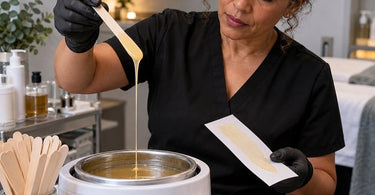
Efficiency drives profits - here's how understanding room temperature can save your waxing services from turning into a sticky little disaster. You load your spatula with what looks like perfectly melted hard wax, glide it across your client's skin, and suddenly the application looks thinner than your patience on a fully booked Saturday. The edges are setting too quickly, your removal tab is practically nonexistent, and you're wondering why the exact same wax behaved beautifully yesterday. Before blaming your wax, your warmer, or the waxing gods, take a look at your treatment room temperature. Cold rooms can change how wax behaves during application, but the actual explanation involves heat transfer, wax viscosity, skin temperature, and technique working together.
Here's the interesting part: a cold room doesn't automatically make wax spread thinner. In fact, cooling generally makes wax thicker and less fluid. What professionals often describe as wax spreading too thin is actually a combination of premature setting, uneven distribution, excessive spatula pressure, and sometimes an overheated wax pot. Understanding that distinction is the secret to fixing the problem instead of accidentally making it worse.
Why Wax Spreads Too Thin When the Room Is Cold
The biggest culprit is often the temperature difference between the heated wax and the surface receiving it. Professional depilatory wax is formulated to become workable when heated and to change consistency as it cools. The moment warm wax touches skin, heat begins transferring away from the product. In a chilly treatment room, cooler skin and surrounding air can accelerate that cooling process.
For professional stripless hard wax, this matters because the product needs enough working time to spread into a continuous, appropriately thick layer before setting. If the wax begins firming while you're still moving the spatula, the application may become uneven. You might drag part of the wax forward while leaving an inadequate layer behind.
The result can look like an unusually thin application, even though the wax itself wasn't necessarily too fluid. You may notice translucent spots, patchy edges, visible skin through the wax, or sections that begin breaking before you're ready to remove them.
Now add an esthetician trying to finish the application before the wax sets. Suddenly, you're pressing harder, stretching the product farther, and creating precisely the thin layer you were trying to avoid. Congratulations, your treatment room has become a tiny science experiment with a very impatient spatula.
The Difference Between Wax That Is Too Thin and Wax That Sets Too Quickly
Before adjusting your equipment, identify which problem you're actually experiencing. These two conditions may look similar on the skin, but their causes and solutions are different.
Wax that is too runny: The product flows rapidly from the spatula, offers little resistance, and may spread into an excessively thin film with minimal effort. This commonly indicates that the wax is hotter than its ideal working consistency, although formulations differ.
Wax that is cooling too quickly: The product initially leaves the spatula at an appropriate consistency but begins thickening, dragging, or setting before the application is complete. Cold skin, cool airflow, slow application, or an unsuitable wax formula may contribute.
Wax that is being overworked: The product initially spreads correctly, but repeated passes or excessive pressure scrape it into an uneven layer. This technique problem becomes more noticeable when the available working time is shortened by a cold environment.
Wax that is too cool in the pot: The product looks stringy, clumpy, or resistant to spreading before it even touches the skin. This suggests that the wax hasn't reached the appropriate working consistency or hasn't been mixed evenly.
Identifying the correct category saves time, reduces unnecessary adjustments, and prevents a very common mistake: increasing the warmer temperature every time an application looks wrong.
Cold Skin Changes the Application Window
Room temperature matters partly because it influences skin surface temperature. A client who has just walked into your salon from chilly outdoor weather may have noticeably cooler skin than someone who has been relaxing in the treatment room.
When heated wax contacts cooler skin, the temperature difference can increase the initial rate of heat transfer. Hard wax may begin firming before you complete the stroke, particularly when the application area is large or your technique involves several passes.
This is especially noticeable during underarm, leg, arm, and bikini waxing, where the size, contour, and temperature of the treatment area can change how easily the product spreads.
Watch for these practical warning signs:
- The wax begins resisting the spatula halfway through application.
- Edges become firm before the center of the application is finished.
- The product leaves streaks instead of a smooth, consistent layer.
- Thin sections crack or tear during removal.
- The wax breaks into multiple pieces rather than lifting as one flexible strip.
- You find yourself repeatedly going over the same area to correct uneven coverage.
These symptoms don't always mean the treatment room is too cold. However, when they appear mainly during winter, first appointments, or periods of aggressive air conditioning, environmental temperature deserves a place on your troubleshooting checklist.
Why Turning Up the Wax Warmer Isn't Always the Answer
Let's talk about the temptation to crank up the professional wax warmer. It seems logical: the room is cold, so the wax should be hotter, right?
Not necessarily.
Raising wax temperature can temporarily make the product more fluid and extend its working time. However, increasing the temperature beyond the manufacturer's recommended application range may create an entirely different problem. Overheated wax can become excessively runny, spread too thin, and increase the risk of burns or skin injury.
That means a cold treatment room can produce a frustrating cycle. The wax starts setting too quickly, so the esthetician raises the warmer temperature. The overheated wax then spreads into an excessively thin layer. That thin layer cools quickly and may become brittle. The esthetician responds by raising the temperature again.
And somewhere in the background, the thermostat is quietly causing chaos.
Instead, follow the specific wax manufacturer's working-temperature instructions. Use the consistency of the stirred product and an appropriate temperature-checking method to confirm its readiness. Remember that a warmer's dial setting doesn't necessarily represent the actual temperature of the wax.
Never compensate for an uncomfortable treatment-room temperature by applying wax hotter than its safe operating range. Check temperature before application, and avoid waxing over irritated or otherwise unsuitable skin.
The Ideal Hard Wax Consistency for Cold-Weather Services
Many professional hard wax formulations are designed to have a smooth, cohesive, honey-like working consistency. The product should load onto the spatula without running off like water, yet remain flexible enough to spread without excessive dragging.
There isn't one universal temperature or thickness that works for every hard wax. Different resins, polymers, application methods, and manufacturer specifications produce different results.
A useful practical test is to lift a clean applicator from the thoroughly melted and stirred wax. Observe how the product behaves as you rotate and move the spatula.
- Too runny: Wax flows rapidly and provides little control. Check whether the temperature exceeds the product's intended application range.
- Too thick: Wax pulls into heavy strands, clumps, or resists spreading. Verify whether the product has fully melted and reached its recommended working condition.
- Ready for application: Wax moves smoothly, remains manageable on the spatula, and allows you to create the layer thickness specified by the manufacturer.
Test the temperature using the manufacturer's recommended procedure before applying it to the client. For hard wax, the finished layer generally needs enough substance and elasticity to lift without breaking. It should not be stretched so far that it becomes nearly transparent unless that specific product is formulated for such an application.
Hard Wax and Soft Wax Behave Differently in Cold Rooms
One of the most important distinctions in professional waxing is understanding the difference between stripless hard wax and soft strip wax.
Hard wax: This product sets on the skin and is removed without a fabric or paper strip. The application must have sufficient thickness and flexibility to grip the hair and lift as a cohesive piece. Applying it too thinly may cause cracking, tearing, or incomplete removal.
Soft wax: Professional soft strip wax is generally designed to be applied in a much thinner layer and removed with suitable strips. A thin, even application is usually desirable, provided it meets the product's instructions and effectively coats the hair.
This distinction matters because the phrase 'my wax is too thin' describes a genuine application problem for many hard waxes but may describe the intended technique for soft wax.
Cold temperatures can still interfere with soft wax services. If the product thickens too quickly, it may drag, create an uneven coat, or become difficult to distribute consistently. However, the solution isn't to apply soft wax as heavily as stripless hard wax.
If your salon offers both systems, keep separate application standards for each. Your team's technique should follow the specific formula, not a universal waxing rule passed down from someone's esthetics school roommate.
Seven Ways to Fix Thin, Uneven Wax Applications in a Cold Treatment Room
1. Stabilize the treatment room temperature.
A consistent, comfortable treatment environment helps reduce changes in skin temperature and application behavior. Avoid directing air-conditioning or heating vents toward the treatment table or open wax pot. Rather than relying on one universal thermostat setting, choose a comfortable room condition and observe how your wax performs within its manufacturer's specifications.
2. Allow clients to acclimate naturally.
Clients arriving from cold outdoor conditions may benefit from a few minutes in a comfortable treatment room before waxing begins. Keep them appropriately draped and comfortable. Never use excessive heat or direct heating devices to prepare the skin for waxing.
3. Check the warmer before the first appointment.
Make sure the wax is completely melted, stirred appropriately, and within its recommended working range. A partially melted pot can produce inconsistent texture, especially when new beads have recently been added. Consider using a suitable temperature-measuring tool when equipment performance is uncertain.
4. Work in smaller sections.
If the wax is setting before you finish spreading it, reduce the application size. A controlled section allows you to maintain an even layer and complete the stroke before the product loses workability. This can be particularly effective on larger body areas.
5. Adjust spatula pressure.
Excessive pressure can scrape wax too thin. Load the applicator appropriately, establish controlled contact with the skin, and spread the product with deliberate strokes. Use professional wax spatulas and applicators suited to the size and contour of the treatment area.
6. Follow the recommended application thickness.
For hard wax, create a smooth, continuous layer with an adequate removal tab according to the formula's instructions. Avoid feathering the product into fragile, see-through edges. For soft wax, maintain the thin, even coating recommended for strip removal.
7. Reevaluate the wax formulation.
Not every wax offers the same working time or flexibility. If your current product consistently becomes difficult to spread in cooler conditions, compare manufacturer guidance for other professional formulas. Some are designed with longer working times or greater flexibility, which may better suit your technique and treatment environment.
Spatula Technique: The Small Adjustment That Can Save an Entire Application
Sometimes the problem isn't the wax itself. It's how the wax moves from the spatula to the skin.
In a cold room, a slow or hesitant application gives the product more opportunity to cool before the stroke is complete. Pressing harder to compensate can create an increasingly thin coating, particularly near the edges.
Instead, focus on loading the spatula with enough product for the intended section, spreading in a controlled motion, and creating an even finish without unnecessary repeated passes.
For stripless hard wax, form the removal tab as directed by the manufacturer so you can obtain a secure grip when the product is ready. The tab shouldn't be so thin that it breaks at the moment of removal.
When testing a new formula, practice on an appropriate training surface or under supervised professional training conditions before introducing it into client services. This helps your team understand its working time, flexibility, and removal characteristics without turning a paying appointment into an unscheduled product demonstration.
Why Thin Hard Wax Breaks, Cracks, or Leaves Hair Behind
Hard wax must remain sufficiently flexible and cohesive to lift from the skin. When applied too thinly, the layer may lack enough structural integrity to withstand removal forces.
As the product cools, it changes from a workable material into a firmer film. If that film is excessively thin, brittle, or uneven, it may fracture instead of lifting in one piece.
This can cause several frustrating results:
- Small wax fragments remain on the skin.
- The removal tab breaks when lifted.
- The wax tears into sections instead of releasing cleanly.
- Hair removal becomes inconsistent because the product hasn't properly enveloped the hairs.
- The service takes longer due to additional cleanup and assessment.
Repeatedly waxing the same skin area can increase irritation and injury risk. If an application fails, assess skin condition and follow the product's safety instructions before deciding whether any further treatment is appropriate. Do not repeatedly apply wax to irritated, lifted, or compromised skin.
A thicker application isn't automatically better, either. Excessively heavy hard wax applications may waste material, take longer to set, and feel cumbersome. The goal is the correct thickness for the formula and treatment area.
The Hidden Role of Air Conditioning and Drafts
You don't need freezing outdoor weather to encounter temperature-related waxing problems. A strong air-conditioning vent can create a localized cool spot directly above your treatment table.
Moving air can increase heat loss from both the wax surface and the client's skin. This is why one waxing station may experience premature setting while another station in the same salon performs normally.
Watch for patterns rather than guessing. Does the issue occur mainly under a ceiling vent? Does it appear during the first appointment of the morning? Does wax perform normally after the treatment room has been occupied for a while?
Simple observations like these can reveal an environmental problem that no amount of spatula practice will completely solve.
If airflow is the issue, redirect the vent where practical, move the treatment setup away from direct drafts, or improve room-temperature consistency. Keep electrical equipment positioned and operated according to its safety instructions, and never block a wax warmer's required ventilation.
Professional Waxing Supplies That Help Maintain Consistency
Reliable waxing depends on a combination of product selection, equipment, applicators, and preparation. Having the appropriate supplies ready can make it easier to maintain consistent results when environmental conditions change.
Start with dependable professional wax warmers for salons and spas that support the wax manufacturer's recommended operating conditions. A suitable warmer should maintain consistent heating, accommodate your service volume, and allow safe handling during a busy appointment schedule.
Next, evaluate your professional waxing supplies, including applicators, preparation products, and removal materials. The right tools make it easier to distribute the intended amount of wax without scraping or overworking it.
Professionals exploring alternative formulations can compare selections from established waxing lines such as ItalWax, Berodin, Cirepil, and Starpil. Each specific formula should be evaluated according to its own application and temperature instructions rather than assumptions about the brand as a whole.
For larger operations, bulk wax deals can support predictable purchasing once you've identified formulas that consistently perform well in your treatment environment. Testing compatibility and technique before committing to substantial inventory can help avoid expensive surprises.
Don't Forget Proper Skin Preparation
Temperature isn't the only factor influencing wax adhesion. Excess oil, lotion, moisture, and product residue can interfere with how the wax contacts hair and skin.
Use suitable pre- and post-waxing products according to the wax manufacturer's directions. Cleanse and prepare the area as instructed, allow necessary products to dry, and assess skin suitability before beginning the service.
Cold weather can also coincide with dry, sensitive, or irritated skin. That doesn't mean every client needs additional oils, powders, or exfoliation before waxing. Preparation should be tailored to the skin condition and the particular wax formula.
Review relevant contraindications, including recent exfoliation, certain topical treatments, skin injury, and other factors identified by the product manufacturer or your professional training. A technically perfect wax application is never worth compromising skin safety.
Build a Cold-Room Waxing Checklist for Your Team
A consistent salon procedure can prevent waxing problems from becoming a daily guessing game. Instead of letting each esthetician adjust the thermostat and warmer independently, create a simple standard operating procedure.
- Check room comfort and airflow before the first appointment.
- Confirm the wax type and manufacturer's application instructions.
- Allow adequate melting time and stir the product as directed.
- Verify the wax is within its safe, recommended working condition.
- Prepare and assess the client's skin appropriately.
- Choose a section size compatible with the wax's working time.
- Apply the correct layer thickness using controlled spatula pressure.
- Observe setting and removal behavior before continuing.
- Record recurring issues associated with specific rooms, equipment, or formulas.
This checklist also makes training easier. If a new team member struggles with excessively thin applications, you can investigate the actual cause rather than simply telling them to work faster.
For multiroom spas and high-volume waxing studios, consider keeping a brief record of room conditions, wax formulas, warmer performance, and recurring application issues. Patterns can help identify whether the problem is environmental, mechanical, or technique-related.
How Cold-Room Waxing Problems Affect Salon Profitability
A thin hard wax application may seem like a minor inconvenience, but repeated technical problems can create measurable operational costs.
Broken wax sections require additional removal time. Uneven applications can increase cleanup. Unnecessary reapplication wastes material and may be unsafe for the client's skin. Equipment adjustments interrupt workflow, while unpredictable appointment durations make scheduling harder.
Consider a practical example. If an avoidable application problem adds three minutes to each of ten daily waxing appointments, that's thirty minutes of treatment-room time affected in one day. Across a busy week, that time could otherwise support more predictable scheduling, sanitation, client consultation, and service preparation.
This doesn't mean rushing the service or reducing application thickness beyond safe specifications. Quite the opposite. The goal is to make the correct technique repeatable so your team can work efficiently without cutting corners.
For spas that purchase wax in volume, consistent application also improves inventory planning. When estheticians use the intended amount of product rather than repeatedly correcting poor coverage, wax consumption becomes easier to forecast.
Frequently Asked Questions About Wax and Cold Treatment Rooms
Does a cold room actually make wax thinner?
No. Cooling generally increases wax viscosity and encourages hard wax to set. An application that looks too thin in a cold room is often the result of wax being dragged, scraped, or spread unevenly as it cools. Alternatively, the warmer may be set too high, creating excessively fluid wax before application.
Should I increase my wax warmer temperature during winter?
Only make adjustments that remain within the specific manufacturer's recommended working range. A colder room may affect how quickly wax loses heat, but overheating can create overly runny wax and increase burn risk. Evaluate the product's actual condition rather than relying solely on the warmer dial.
Why does my hard wax break when I remove it?
Possible causes include an application that is too thin, insufficient flexibility, improper wax temperature, unsuitable removal timing, or technique issues. Cold conditions can contribute to faster setting, but the wax formulation and application thickness also matter.
Why does wax work perfectly in one treatment room but not another?
Different rooms may have different temperatures, airflow patterns, treatment-table locations, warmer performance, or operating procedures. Compare those variables systematically before assuming the product is defective.
Can I use the same application thickness for every hard wax?
No. Hard wax formulations vary in flexibility, viscosity, setting time, and recommended thickness. Follow the instructions for the specific product you're using.
Is soft wax supposed to be applied thinly?
Yes. Many soft strip waxes are specifically designed for thin, even application and removal with appropriate wax strips and rolls. The problem arises when the layer is uneven, insufficient to coat the hair, or otherwise inconsistent with the manufacturer's directions.
Would changing wax brands solve the problem?
Possibly, but not automatically. Different formulas can offer different working times and handling characteristics. Start by checking room conditions, warmer performance, and application technique. If those factors are controlled and the problem persists, comparing wax formulations may be worthwhile.
The Bottom Line: Control the Environment, Not Just the Wax
A cold treatment room can absolutely complicate professional waxing, but understanding the real cause makes troubleshooting much easier. Cooler skin, drafts, shortened working time, excessive spatula pressure, and inappropriate warmer settings can all contribute to thin or uneven applications.
The solution isn't simply turning up the heat or piling on more product. It's maintaining a comfortable treatment environment, following manufacturer temperature guidelines, choosing the correct application thickness, and developing a repeatable technique.
At Pure Spa Direct, we help spa and salon professionals source the equipment, wax formulas, and accessories that support dependable services. Explore our waxing supplies for professionals, compare professional wax warmers, and find the tools that best fit your treatment menu and workflow.
Because your wax should be making smooth moves, not auditioning for the role of the world's most dramatic beauty product. Keep the room comfortable, the consistency controlled, and the application intentional. Your clients, your schedule, and your sanity will thank you.
