
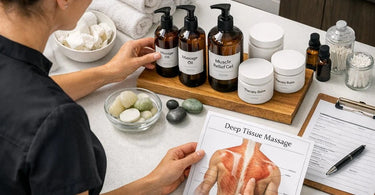
Elevate treatments effortlessly with the secret that turns "too deep, that hurts!" into "when can I book again?" Let's be real, for a minute, Deep Tissue Massage has a reputation. It's the bad boy of the spa world. Clients think it has to hurt to work, and too many therapists believe that if there aren't grimaces and muffled screams, they aren't doing it right. We are here today, armed with professional massage and wellness products and a whole lot of common sense, to bust that myth wide open. Deep tissue work should be transformational, not traumatizing. You can get incredible results, releasing chronic tension and those stubborn knots, without making your client dread their next appointment. In fact, when done correctly, they'll be begging for more. So, grab your favorite massage oil, and let's dive into the art of pressure scaling, the magic words to say, and the aftercare that seals the deal.
Think of pressure scaling like a dimmer switch, not an on/off button. Too many of us are trained like we only have two settings: feather-light Swedish or elbow-drops-of-doom. The sweet spot for deep tissue lives in the vast, glorious middle. It's about matching the pressure to the tissue's current ability to relax, not your ego or your client's machismo. We call this "therapeutic tension" – that "hurts so good" feeling where the client can breathe into the work, not brace against it. Your first clue is their breathing. If they're holding their breath, you've gone too far, hot stone or not. Back off, find the layer where the muscle unlocks, and then you can slowly, mindfully sink in. Your massage table is a stage for healing, not a wrestling ring.
Pressure Scaling: The Dimmer Switch Technique
Let's break down the "how." Start with superficial compression. Just lean your forearm into the spa bedding and let gravity do the work. No muscle engagement from you, just weight. Then, as you feel the superficial muscles release, you add a micro-movement – a slow, small circle or a transverse friction. The client's job? To tell you if it feels like a "good stretch" or a "sharp/ electric/ stabbing" sensation. We only work in the "good stretch" zone. If you hit a trigger point, don't just lean on it like you're trying to pop a champagne cork. Find the barrier of that knot, apply gentle, sustained pressure (for about 30-90 seconds), and wait for the "release" – a softening or melting feeling under your fingers. That, my friend, is the sound of one knot clapping. And portable massage tables work great for this, but stability is key, so make sure your table doesn't wobble!
Your New Best Friend: Communication Scripts That Work
Okay, let's talk about what to say. Because "How's the pressure?" is a terrible question. It puts the client on the spot and they'll almost always lie and say "fine." Instead, use directive and comparative language. Try these scripts on for size:
- The Stretch vs. Pain Script: "As I work this area, I want you to think of a deep stretch, like in yoga. Let me know if it ever crosses over into a sharp, electric, or stabbing pain. We don't want that. We just want the productive "hurts so good" feeling."
- The Breathing Cue: "Take a deep breath in, and as you exhale, imagine that muscle melting right into the table warmer. I'll match my pressure to your exhale." (Then actually do it – sink in a tiny bit more on the exhale).
- The 1-to-10 Scale (Redefined): "On a scale where 1 is a light Swedish stroke and 10 is someone digging a fork into your hamstring, let's stay in a 6 or 7. That therapeutic zone. What number are you feeling right now?"
- Check-Ins That Don't Annoy: Instead of "OK?" every two minutes, say: "Remember, you're the boss of your body. If at any point you need me to ease up or change technique, just wiggle your toe on this side. I'll check in with a verbal "all good?" once more on the other leg."
And for the love of all that is holy, if they say "that's a little sharp," do NOT say "but that's the knot." Say: "Thank you for telling me. I'm backing off 20%. Let's find the edge of that sensation where it feels like a productive release." Respect breeds return clients.
The Products That Make Pain-Free Deep Tissue Possible
You can't do this work without the right tools. Dried-out cotton rounds and crappy lotion that turns to glue? That's how you get drag, and drag creates friction, and friction creates pain. You need glide and grip, in that order. Start with a high-quality massage oil like Bon Vital's or Biotone – something that gives you slip for the broad strokes but has enough "grab" for the specific friction work. For those stubborn adhesions, a little Prosana Muscle Relief Gel is a game-changer. It warms up the tissue without a heating unit, increases blood flow, and makes the muscle more pliable before you even start. And afterward? A cold pack or a topical arnica cream can be a lifesaver for the client who is a little sore 24 hours post-session. Stock your treatment room with the good stuff from Earthlite tables to high-quality towels from Boca Terry. Your hands (and your clients) will thank you.
Aftercare That Prevents the "I'm So Sore" Text
Let's face it: most "pain complaints" happen the next day. They wake up feeling like they were hit by a truck, and they blame you (and your technique). The solution? Proactive aftercare that you sell as part of the experience. Before they even get off the massage chair or table, tell them: "You might feel a little "awareness" in those areas we worked tomorrow – like a good workout soreness. That's the inflammation process doing its job. To minimize that, I recommend you do three things." Then hand them a take-home card (or sell them the products!).
- Hydrate or Die-drate: "Drink half your body weight in ounces of water today. Flush out those metabolic wastes we just released."
- Heat vs. Ice: "If you feel general soreness, use a heating pad for 15 minutes to increase blood flow. If you feel a sharp, specific spot, use an ice pack wrapped in a towel for 10 minutes to calm inflammation."
- Stretch It Out: Show them ONE simple stretch for the area you worked. "Hold for 30 seconds, three times today." This makes them an active participant in their own healing.
- Retail the Relief: This is where you save their future and boost your bottom line. Have a small retail section with massage lotions for home use, ingrown hair products if you also wax, and those massage bolsters for home stretching. Sell them a muscle relief gel or a small basalt stone for self-massage. Make it easy. Make it feel essential. Because when they use that gel and feel better, they don't credit the gel – they credit you for being a genius.
Real-World Scenarios: What to Say and Do
Let's practice. Scenario A: Client has cupping marks from last week and says, "I love deep work, but last time I couldn't move my neck for two days." Translation: they were traumatized. Your response: "I hear you. My deep tissue is different. We work together. Today, we'll use pressure scaling – starting at a 5 out of 10. Your only job is to tell me if we cross into a 7 where it feels sharp. Deal?" Then use more massage cream than usual for extra slip and spend the first 10 minutes just doing warm, broad effleurage to calm their nervous system.
Scenario B: The gym bro who says, "I can take it. Don't be gentle." Red flag! Your job is to educate, not comply. "Awesome that you have high pain tolerance. But my goal isn't to test your tolerance – it's to release the fascia and get blood flow to those quads. Real change happens in the 6-7 zone, not the 9-10 zone. Let me show you what a 7 feels like." Then demonstrate, and watch his face go from "bring it" to "oh, that IS good."
Products That Support a Pain-Free Practice (Shameless but Useful Plug)
Look, we are Pure Spa Direct, and we sell the gear that makes this magic happen. You need a stable, comfortable portable massage table? We've got Earthlite. You need table warmers that don't short out? thermaBliss is your new BFF. You need towel steamers for that post-massage hot towel ritual? We have those, too. And don't forget the linens – Boca Terry robes and sheets make your client feel like royalty. Even if you're a hair salon adding massage, or a lash and brow studio offering "stress relief" add-ons, the principles are the same. Respect the tissue, communicate like a pro, and sell the aftercare. Your client retention will skyrocket, and you'll be known as the "deep tissue guru who doesn't hurt me." And that, my friend, is a reputation worth its weight in basalt stones.
So go forth, adjust that pressure, use your words, and stock up on the good stuff. Your hands (and your happy, returning clients) will thank you. Now, if you'll excuse me, I have a date with a Vichy shower and a very patient massage bolster. Happy scaling!
