
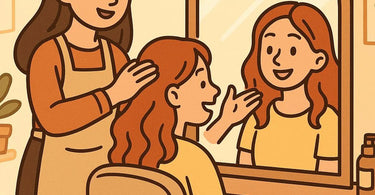
Deliver quality that clients can see... starting with teaching them how to actually see their own hair. We've all been there: a client sits in your chair, points to a Pinterest photo of a celebrity with completely different hair texture, density, and face shape than theirs, and declares "I want this!" Meanwhile, you're staring at their reflection wondering if they've ever actually looked at their own hair before. The truth is, most people haven't. They see their hair as a problem to be solved rather than a canvas to be celebrated. That's where the "Mirror, Mirror" moment comes in – that beautiful, transformative instant when you teach a client to truly see what you see.
This isn't just about giving great haircuts or color – it's about creating clients for life by giving them the gift of hair literacy. When clients understand their hair's unique characteristics, they become partners in the creative process rather than passive recipients. They stop fighting their natural texture and start working with it. They understand why that "wash and go" beach wave requires seven products and a specific blow dryer technique. Most importantly, they appreciate your expertise on a whole new level.
The Art of the Double Mirror Technique
Every great hair consultation begins with what I call the "Double Mirror Technique." No, this isn't some mystical ritual involving chanting and crystals (though if that works for you, no judgment). It's about using two perspectives: yours and theirs. Start by having the client hold a hand mirror while you stand behind them with the salon mirror reflecting back. This simple setup creates an immediate shift – they're no longer just staring at their face, they're seeing their hair as a three-dimensional entity.
As you guide them through this process, use a professional detangling brush to section their hair gently. Point out what you see: "Notice how your hair grows in this direction here? That's why it always falls this way naturally." or "See how the texture changes from root to ends? That tells me your hair is naturally..." You're not just pointing out features – you're teaching them the language of hair.
Reading the Map: Density, Texture, and Porosity
Think of every head of hair as a unique geographical map. Your job is to teach clients to read their own terrain. Start with density – how many hairs per square inch. Have them look at their scalp through the mirror. Is it sparse like a meadow or thick like a forest? This determines everything from cutting techniques to product recommendations.
Next, texture – the diameter of individual strands. Compare it to thread: fine like silk sewing thread, medium like cotton thread, or coarse like yarn. This is where having quality professional shears makes all the difference in how you approach the cut.
Then there's porosity – how well hair absorbs and retains moisture. The "float test" is fun to demonstrate: take a strand of clean hair and drop it in a glass of water. If it floats, it's low porosity (resists moisture). If it sinks slowly, it's normal. If it plummets like my dating prospects after I mention I own 37 cats, it's high porosity (absorbs moisture quickly but loses it just as fast). This knowledge transforms how clients approach deep conditioning treatments and styling products.
The Growth Pattern Tango
Nothing creates more "aha!" moments than showing clients their hair's growth patterns. That stubborn cowlick they've been fighting for years? Show them how it creates natural volume right where many people pay for it. That double crown they thought was a styling failure? Demonstrate how it gives their hair beautiful movement.
Use a tail comb to gently direct hair in its natural growth direction, then against it. "See how it wants to sit here naturally? When we work with that pattern instead of against it, your style will hold better with less product and effort." This is where you can introduce them to the magical world of professional round brushes and how different sizes create different effects based on their natural patterns.
Face Shape: The Frame Matters
Here's where the magic really happens. Most clients focus on their perceived flaws – "My forehead's too big," "My face is too round," etc. Flip the script by teaching them how hair frames and enhances their unique features. Use the hand mirror to show them how different part placements change the apparent shape of their face.
"Notice how a deep side part elongates your face?" or "See how these face-framing layers draw attention to your eyes?" This isn't about "correcting" anything – it's about creating harmony. While you're at it, make sure your station is equipped with proper magnifying lights so you can both see every detail clearly.
The Color Conversation
Color consultation becomes infinitely more productive when clients understand their starting canvas. Use the salon mirror to show them the natural variations in their hair color. "See how the ends are lighter and warmer than the roots? That's your hair's natural sun-kissed pattern."
Explain how professional hair color interacts differently with various textures and porosities. "Because your hair is more porous at the ends, color will grab differently there – that's why we need to apply the formula strategically." Suddenly, that "unexpected" color result becomes completely predictable to them.
Turning Knowledge Into Action
The real value of the Mirror Mirror moment comes when clients leave your chair armed with practical knowledge. Create a simple "Hair Profile Card" for each client noting their density, texture, porosity, growth patterns, and face shape. This becomes their personal hair roadmap.
Then, demonstrate how this knowledge translates to at-home care. Show them why a sulfate-free shampoo might work better for their porous hair, or why a thermal protectant is non-negotiable for their fine texture. This is where having quality premium hair care products available for retail makes perfect sense – you're not selling to them, you're solving problems you just helped them identify.
The Styling Tutorial They Actually Understand
Instead of the standard "blow dry like this" demonstration that leaves clients mystified, use the Mirror Mirror method to explain why certain techniques work for their specific hair. "Because your hair is fine but dense, we need to use tension with the round brush to smooth the cuticle while directing the airflow down the hair shaft."
Show them how to identify when their hair is properly dry (that certain feel and look), how to use professional flat irons at the right temperature for their texture, and why sectioning matters for their specific density. Suddenly, your styling advice stops sounding like magical incantations and starts making practical sense.
Building Trust Through Transparency
When clients feel truly seen and understood, they stop being one-time visitors and become lifelong clients. The Mirror Mirror moment builds incredible trust because you're not just telling them what to do – you're showing them why. You're demystifying the process and sharing your expertise in a way that empowers them.
This approach also sets you apart in a crowded market. Anyone can copy a haircut from Instagram, but no one can replicate the educational experience you provide. While you're creating these magical moments, make sure your salon is equipped with comfortable salon furniture and efficient shampoo bowls to complete the professional experience.
The Business Benefits of Better Looking
Beyond the warm fuzzies of helping clients feel understood, this approach has tangible business benefits. Educated clients are more likely to: book regular appointments (they understand what "grown out" actually looks like), purchase recommended products (they know why they need them), refer friends (they want their friends to have the same enlightening experience), and trust your recommendations for services like professional perms or keratin treatments.
They also become more realistic about what's achievable, which means fewer "I hate it" moments and more satisfied clients walking out your door. Plus, when they understand the science behind the style, they're often willing to invest in better tools like professional hair dryers and higher-quality professional nail services for that complete head-to-toe confidence.
Creating Your Own Mirror Mirror Magic
Ready to implement this in your salon? Start small. Choose one client per day to practice the full Mirror Mirror consultation with. Have your tools ready – a clean hand mirror, proper lighting, a sectioning clip, and your knowledge.
Remember, you're not just a stylist – you're an educator, a translator between clients and their hair. The next time someone sits in your chair dreaming of being someone else, give them the gift of seeing how amazing they already are. That moment when the lightbulb goes on, when they truly see their hair for the first time? That's not just good business – that's beauty magic.
