
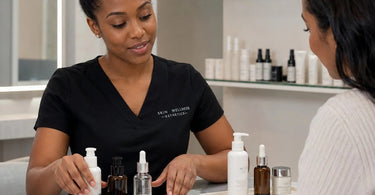
Tools designed to meet your needs... but honey, even the best Premium Skincare Products in the world can turn into a hot mess if you don't know the secret handshake. I'm talking about the beauty version of a bad blind date—two seemingly amazing things that just do NOT belong together. You've seen it happen. You spend forty-five minutes perfecting a client's facial, using your most expensive serums, and then they go home, slather on a random drugstore moisturizer over it, and text you the next morning with a picture of their face looking like a flaky croissant. Or worse, they ask you why your expensive treatment didn't work. It's not you, babe. It's the layering. Or, more accurately, the complete lack thereof. We are going to dive deep into the beauty blender of chaos that is product layering and figure out exactly what you need to teach your clients to save their skin—and your reputation.
Look, as professionals, we have the training to know that just because two products are good doesn't mean they are good together. But clients? They see a shelf full of pretty bottles and think, 'More is more!' It's our job to gently guide them away from the skincare cliff. We need to explain that mixing certain ingredients is like mixing a fine wine with a can of soda—it just ruins both. And sometimes, it can literally cause a chemical reaction that negates the benefits of both products or, even worse, irritates the skin. So, grab your favorite beverage, put your feet up, and let's talk about how to be the hero your clients' skincare routines desperately need.
What Even Is Product Layering and Why Does It Matter So Darn Much?
First, let's get on the same page. Product layering isn't just a fancy term for 'putting stuff on your face.' It's the art and science of applying products in a specific sequence to maximize their effectiveness. Think of it like building a sandwich. You wouldn't put the bread on top of the turkey and then put the lettuce on the bottom, right? You follow an order because it just works better. Similarly, with skincare, we go from thinnest to thickest in texture, and water-based before oil-based.
Why? Because the thinner, more watery products like serums and toners are designed to penetrate the skin, delivering active ingredients deep down. But if you slap a thick, heavy oil or cream on first, you are basically putting a plastic wrap barrier on the skin that prevents everything else from getting through. It's skincare sabotage! The whole point of a professional skincare routine is that every step builds on the last. A good esthetician knows how to layer with intention, choosing products that support the skin's barrier and perform together harmoniously.
But for the average client? They think a 12-step routine means using 12 different heavy creams from 12 different brands all at once. And that, my friends, is how you end up with a face full of pilling, irritation, and zero results. They are literally canceling out the work you did.
The Golden Rule: Let's Get Thinnest to Thickest
This is the one rule your clients MUST engrave on their bathroom mirrors. It is the non-negotiable foundation of a good routine. I tell my clients all the time, 'If you want your expensive serum to actually work, you have to apply it before your heavy cream.' It sounds simple, but you would be surprised how many people get this backward.
Here is the exact order a professional esthetician will recommend, also backed by dermatologists.
- Step 1: Cleanse. You can't build on a dirty surface. Get that makeup, grime, and SPF off.
- Step 2: Tone. This preps the skin and restores pH balance so the next steps absorb better. Think of it as opening the pores to say, 'Okay, come on in!'
- Step 3: Water-Based Serums & Treatments. This is where the magic happens. Hyaluronic acid, vitamin C, niacinamide—these watery heroes need to get deep into the skin to do their job. Put them on before anything heavy.
- Step 4: Moisturizer. This is the barrier that seals in all that goodness and prevents water loss. It's like closing the vault.
- Step 5: Oils. Oils are occlusive. They sit on the surface and lock everything in. They go last, people! Or at nighttime. If you put an oil on before a water-based serum, you're just wasting the serum because it can't get through the oil barrier.
My favorite analogy for clients is: if you put on a winter coat before your t-shirt, does it make sense? No! Same thing. Start light, end heavy.
Actives That Are Frenemies: The 'Do Not Mix' List
Now, here is where it gets really juicy. Texture is one thing, but chemistry is a whole other ballgame. Some ingredients are just not friends. In fact, they can be downright hostile to each other. Mixing the wrong actives can lead to irritation, chemical burns, or just straight-up canceling each other out.
This is a huge selling point for your retail offerings. When you can explain to a client why your specific brand products are formulated to work together, they are far more likely to buy the whole system than just one serum from you and then go buy a random moisturizer from the drugstore. So, here are a few of the biggest 'frenemies' in the skincare world to warn your clients about:
- Retinol + Exfoliating Acids (AHAs/BHAs): This is a classic case of too much of a good thing. Retinol is already a chemical exfoliant and cell-communicator. Adding glycolic or salicylic acid on top is like taking a belt sander to your face. Unless your client has skin made of titanium, it will lead to redness, peeling, and a compromised barrier.
- Vitamin C + Strong Acids: While Vitamin C (ascorbic acid) is amazing for brightening, its pH is quite low. Mixing it with other strong acids can cause a chemical reaction that makes both less effective and can even irritate the skin. It's better to use Vitamin C in the morning and reserve your acids for night.
- Retinol + Benzoyl Peroxide: These two are supposed to be acne-busting superheroes, but together? They fight. Benzoyl peroxide can actually oxidize and deactivate retinol, rendering it useless. Not to mention the combo can be incredibly drying.
- Copper Peptides + Vitamin C: This is another case of 'oil and water.' The pH of Vitamin C can break down the copper peptides, making them ineffective. Use one in the morning and one at night to be safe.
When you're stocking your shelves with Professional Skincare lines like Murad, you can confidently tell your client, 'Our Vitamin C and our Retinol are designed to be used in separate routines, but if you want the ultimate glow, I have a system that uses them at different times of day.' This education positions you as the expert and creates a huge trust factor that leads to retail sales.
And Speaking of Oil... Why You Shouldn't Layer Everything
Okay, let's talk about the oil myth. I cannot tell you how many clients I see who think that if they have dry skin, they just need to slather themselves in oil. And they will do it at the start of their routine because... well, they think it's nourishing. WRONG! As I mentioned before, oils are an occlusive barrier. They block things.
If you have a client who is a 'skinimalist' (or just lazy, no judgment), tell them that a good routine doesn't need to have a million layers. A good cleanser, a targeted serum, and a quality moisturizer are often enough. You don't need to layer a toner, an essence, three serums, a moisturizer, and an oil. That's just... product overload. It's a great way to waste money and potentially break out. Estheticians often recommend simpler routines that are better for the skin barrier.
Also, if a client is layering a lot of products, they need to wait. I know they are in a rush. I know we all are. But if they don't wait 60 seconds between layers for the products to absorb, they're just mixing everything together on their face, which can cause pilling and block absorption. Tell them to put on their serum, then brush their teeth. By the time they are done, they can put on their moisturizer. It's called multitasking, babe.
Pilling: The Tell-Tale Sign of a Layering Disaster
We have all seen it. The dreaded little balls of product that roll off the face like eraser shavings. Clients panic and think their skin is peeling. Nope. It's a chemistry experiment gone wrong. Pilling is a sign that the products aren't absorbing. It can be caused by several layering mistakes: applying too much product, applying a silicone-heavy product over a water-based product, or rushing and not letting each layer dry down.
This is a great opportunity to educate. When I see pilling on a client, I say, 'Oh, I can see we need to adjust our layering order! This usually happens when the ingredients are fighting for real estate on the skin.' I can fix it in my treatment room with my products, but at home, they need to know. A common culprit is using a primer with high silicone content on top of a water-based serum. The polymer molecules in the silicone just roll up and grab the serum with them.
Encourage them to invest in products that are designed to work together. When they buy a new system from you, tell them, 'This is formulated so you don't get pilling.' Must-Have Spa Retail Products should be simple and effective. Or, if they love their current routine, teach them to let each layer dry down for a minute before applying the next. This simple step can work miracles. This is why having a Facial Steamer in the treatment room is awesome—the steam hydrates the skin, but you have to be careful not to steam too long after applying certain serums that need to set!
Retail Ready: How to Sell the 'Science' of Layering
Knowledge is power, and in this case, it's also profit. You are not just selling a Cuticle Oil or a Premium Skincare Products; you are selling a result. And results come from a system.
When you are at the checkout counter or doing a consultation, explain the 'Why.' For example, if a client is buying your Premium Skincare Products, you can say, 'This serum is water-based and will absorb beautifully. But to really seal in the hydration, you need a moisturizer that acts as a barrier. If you use just the serum, the water evaporates. If you use just a cream, it doesn't penetrate. They work together to give you that glow you saw in the treatment room.' Graham Beauty products are great for this. Bottles & Jars can be used to pre-mix sample kits of your layered system, so they know exactly what order to use them in at home.
Make it easy for them. Create a simple 3-step regimen card. 'Cleanse, Treat, Moisturize.' Simplicity wins. And when they come back a month later and their skin looks incredible, they will be your client for life.
So, the next time a client looks at you with confusion and asks, 'How do I put this on my face?' Don't just hand them the bottle. Teach them the layering law. Tell them that thinnest-to-thickest is the way to go, and that some ingredients are just frenemies. It will save their skin and keep them coming back to you for more wisdom.
Skincare Products are an investment. Make sure your clients know how to protect their investment. You are not just a service provider; you are a skin health educator. And that, my friends, is a very profitable position to be in.
)