
The first step to better results in your beauty business might actually be shutting up about the 'how.' I know, it sounds wild, right? We spend hours perfecting our craft, taking continuing education on the latest Advanced Facial Treatments, and learning the science behind every peel and polish. So, naturally, when a client asks what we are doing, we want to show off our smarts. We want to prove we are worth every penny by narrating every single step. But here is the tea, bestie: when you start mansplaining the pH balance of your Premium Skincare or detailing the exact molecular structure of your Professional Stripless Hard Wax, you are actually setting off little alarm bells in their heads. They start to worry that you are trying to justify your price, or worse, that you don't actually know what you are doing. It is the beauty industry version of a first date where someone talks about their ex the whole time; it just kills the vibe. Today, we are going to unpack the psychology of why less is truly more when it comes to explaining your magic, and how focusing on the 'what' (the amazing results) instead of the 'how' (the nitty-gritty) will turn those one-time visitors into lifelong ride-or-die clients.
Think about the last time you had a procedure done. Did you want the dentist to explain every grinding noise? Or did you just want them to fix the cavity and let you watch Netflix? The same logic applies to your Waxing or Lash & Brow Enhancement services. When you over-explain, you shift the client's focus from the relaxing experience to a technical lecture. They stop feeling the soothing warmth of the Towel Steamers and start counting the steps. Suddenly, they are an auditor instead of a guest. And auditors look for problems. They start questioning your Professional Cleaners or wondering if that specific angle of your Quality Wax Strips was 'textbook.' It is exhausting for them and for you. We want them to enter a state of trust, a zen-like flow where they know they are in good hands without needing to see the manual. The goal is to make them feel like a VIP, not a student in a crash course on esthetics.
The Psychology of Trust: It is a Feeling, Not a Spreadsheet
Here is the hard truth: Clients buy feelings, not facts. They come to you to fix a problem (acne, hairy legs, tired skin) or to achieve a dream (glowing skin, perfect brows, relaxation). They do not wake up thinking, "I really hope my esthetician uses a High Frequency Machine with a specific argon gas setting." They wake up thinking, "I want to look good for my vacation." Over-explaining breaks the emotional spell. According to industry experts, focusing on the customer's journey and the tangible benefits they gain is key, rather than drowning them in technical jargon. When you use buzzwords or overly complex language, it can actually bewilder customers and make them wary .
When you launch into a five-minute monologue about how your Hydrodermabrasion machine uses vortex suction to dislodge dead skin cells, you might lose them at 'vortex.' They stop trusting that you know what is best because you are working so hard to convince them. It is like when someone says, "Trust me," too many times; you immediately don't trust them. True expertise is quiet confidence. It is the stylist who just picks up the Professional Shears and cuts without hesitation. It is the nail tech who grabs the Professional Gel Polish and just does the thing. That silence? That is loud. It screams, "I have done this ten thousand times. Relax."
The 'Friend Zone' vs. The 'Lecture Hall'
We talk a lot in this industry about building loyalty. Studies show that emotional connection, not just discounts, drives repeat business . You want to be in the 'friend zone' with your clients (the good kind, where they bring you cookies and tell you about their dog). You do not want to be in the 'Lecture Hall' zone where they sit stiffly and take mental notes. When you over-explain, you create a power imbalance that feels icky. You are the 'expert' talking down, and they are the 'ignorant' client listening up. That is not a friendship; that is a seminar.
Instead, treat them like a friend. If a friend has a pimple, you don't explain the entire Galvanic Machines process. You say, "Girl, I got you. This little zap is going to dry that thing out by tomorrow." See the difference? The first is a dissertation; the second is a promise. You are selling the outcome (clear skin), not the voltage. Use the WIFM principle — What's In It For Me? Speak to the specific pain points, aspirations, and outcomes that matter to your audience . Focus on the 'what' — "This will make your skin glow" — rather than the 'how' — "This uses galvanic current for deep cleansing." Keep your language simple, benefit-driven, and warm. You are a problem solver, not a textbook.
When Details Backfire: The 'DIY' Disaster
Here is a secret that might keep you up at night: If you explain your process too well, you might talk yourself out of a job. Seriously. I have seen it happen. A brow artist explains exactly how she maps the brow using the golden ratio, what Brow Henna she uses, and the specific angle of her Tweezers. Suddenly, the client thinks, "Wait, I can buy that on Amazon for $15. Why am I paying $75?"
This is the danger of revealing your intellectual property without protecting it . Your process is your secret sauce. If you give away the recipe, why would they come back to the restaurant? You are paying for your years of experience, your steady hand, your Professional Wax Warmers that are calibrated perfectly, and the ambiance of your clean, licensed studio. But if you focus only on the tools, the client devalues the artist. They see the ItalWax pot, but they miss the technique. Keep some mystery. Let them assume it is magic, because frankly, to them, it should be. If they could do it themselves, they wouldn't be lying on your Portable Massage Tables.
How to Sound Like a Pro (Without Sounding Like a Robot)
So, how do we fix this? Do we just grunt and point at the bed? No. Communication is still key, but it needs to be high-vibe communication. Ditch the scripts that sound like they came from a manual. Never ask, "Does that make sense?" This phrase is a killer. It conveys doubt in your own ability and implies the client is too dumb to get it . Instead, ask, "How does that feel?" or "Isn't that relaxing?" This keeps the focus on their sensory experience.
When you are doing a service, narrate the feeling, not the physics. Instead of saying, "I am now using a Ultrasonic Skin Scrubber to emulsify sebum," say, "You are going to feel a gentle vibration right here that helps sweep away the dullness." Instead of listing the ingredients in your Sugar Scrubs, say, "This smells good enough to eat, and it is going to leave your legs feeling like silk." You are painting a picture of the result. You are anchoring the pleasure, not the procedure. This builds trust because you are guiding their expectation to a positive outcome rather than questioning their comprehension.
Curating the Experience: Let Your Tools Do the Talking
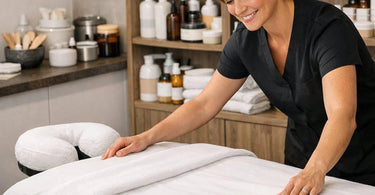
Sometimes, the best explanation is no explanation at all—just the visual of a pristine, organized space. Trust is built through consistency and environment . When a client walks in and sees your Nail Tables and Manicure Stations are spotless, your UV Sterilizers are humming, and your High-Quality Towels are fluffy and white, they trust you. You don't need to say, "I sanitized my tools." They can see the autoclave bag. You don't need to say, "I use high-end products." They can see the OPI or CND logos.
Your environment is a silent salesperson. If you have a messy station and you over-explain, you look chaotic. If you have a clean station and you are quiet and confident, you look like a god(dess). Invest in the quality of your Spa Essentials and let the results speak for themselves. When you hit a home run (the color is perfect, the wax didn't hurt, the skin is glowing), they will ask you what you did. That is when you can share a little detail. But let them ask first. That curiosity is the gateway to upselling retail products like your Must-Have Spa Retail Products because they want to buy the magic for home.
Real Talk: It is About Their Results, Not Your Resume
I want you to remember a golden rule: The client is the hero of the story, not you. You are the wise mentor (think Yoda or Mary Poppins). You show up, do the impossible, and make them feel amazing, but you don't brag about how you did it. You just smile mysteriously. When you over-explain, you make the story about your hard work. When you under-explain (in a confident way), the story is about their transformation.
If a client is looking at your Professional Wax Spatulas and asking too many questions, redirect them to the outcome. "I know, the tools look serious, right? Don't worry, I've got the gentle stuff here. We are using ItalWax Pre/Post products to make sure your skin stays happy long after you leave." See how that works? You answered the question but immediately pivoted to the long-term benefit (happy skin). You reassured them without making them feel like they were in science class. This approach shows that you are focused on their well-being, not your ego.
Time to Zip It (And Let Your Magic Speak)
Ladies, I know you are brilliant. I know you took that class on Dermaplaning or Brow Lamination and you aced the anatomy quiz. But your client does not need to see your report card. They need to feel your confidence. Next time you have a client in your chair, whether you are doing a Pedicure or a Body Wrap, try a little experiment. Silence the internal narrator. Turn down the verbal volume. Replace the word 'because' with a smile. You will likely see them physically relax. Their shoulders will drop. They will close their eyes.
That silence? That is the sound of trust. You are not being paid to be a Google search engine. You are being paid to be a magician. And a true magician never reveals all their secrets. So, zip it, babe. Go make some magic with your Microcurrent Machines and LED Bright Lamps, and watch your retention rates soar when they realize they can't live without the mystery that is you.
)