
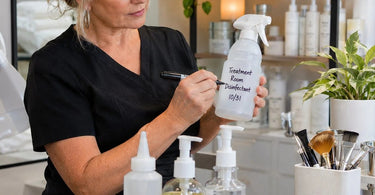
Simplify. Improve. Succeed... Three little words that sound like a motivational poster in the break room, but they also describe one of the smartest safety habits a salon owner can establish: labeling secondary containers correctly. That innocent-looking spray bottle sitting beside your manicure station might contain surface disinfectant, cleaning solution, or something entirely different. If nobody knows what is inside, your team is playing a guessing game with chemicals, and that is definitely not the kind of excitement anyone booked an appointment for. Proper secondary container labeling protects employees, supports regulatory compliance, reduces expensive mistakes, and helps busy beauty professionals work confidently.
From hair color stations and nail salons to waxing rooms, spas, and barber shops, professionals routinely transfer products from original packaging into smaller working containers. Sometimes this makes perfect operational sense. A gallon of cleaning concentrate is not exactly convenient to carry between treatment rooms, and an oversized chemical container does not belong on every workstation. However, transferring a hazardous chemical into another container can create additional labeling responsibilities. Understanding those responsibilities is an essential part of running a safe, efficient, professional beauty business.
What Is a Secondary Container in a Salon?
A secondary container is a bottle, jar, spray bottle, dispenser, or other vessel used to hold a substance transferred from its original packaging. In professional beauty environments, these containers appear everywhere. Think refillable cleaning bottles, smaller containers of salon disinfectant, chemical-resistant dispensing bottles, and working containers used for certain professional treatment products.
For example, your team might transfer a compatible cleaning solution into a smaller spray bottle used at a manicure station. A stylist might use a clearly identified dispensing container for a salon chemical, or a spa employee might prepare an approved diluted disinfectant solution in a designated container.
These arrangements can improve convenience and reduce clutter, but only when employees can reliably identify what the containers hold.
Professional Bottles & Jars can help organize products across treatment areas. However, purchasing appropriate containers is only the beginning. The container must be chemically compatible with its contents, suitable for the intended use, and labeled whenever applicable regulations require it.
Why Correct Secondary Container Labels Matter
Picture this: It is Saturday morning, every appointment slot is booked, and your newest employee reaches for an unlabeled spray bottle. She assumes it contains the same gentle surface cleaner used yesterday. Unfortunately, someone refilled the bottle with a different chemical after closing. Suddenly, a simple cleaning task has become a preventable safety problem.
The issue is not whether employees are careful or experienced. Even excellent professionals cannot reliably identify an unknown chemical from its appearance, color, or scent.
Correct labeling helps prevent accidental exposure, incompatible chemical use, damaged equipment, inappropriate cleaning procedures, and confusion during emergencies. It also helps employees quickly locate the appropriate safety information when something goes wrong.
There is a business benefit, too. A well-organized treatment room communicates professionalism. Clear product identification makes it easier to train employees, maintain consistent procedures, and keep workstations functioning smoothly during busy shifts.
What OSHA Says About Secondary Container Labeling
For many U.S. salons and spas, the Occupational Safety and Health Administration, commonly known as OSHA, provides an important regulatory framework through its Hazard Communication Standard, 29 CFR 1910.1200.
This standard generally requires covered employers to communicate information about hazardous chemicals in the workplace through appropriate labeling, safety data sheets, employee training, and a written hazard communication program.
Under OSHA's workplace labeling provisions, containers of hazardous chemicals must generally carry either the applicable shipped-container label information or a permitted workplace label that identifies the product and communicates its hazards. A workplace label can use words, pictures, symbols, or a combination of these elements, provided it conveys general hazard information and works with other immediately available information to give employees the specific physical and health hazard details.
This distinction matters because a secondary workplace container does not necessarily need an identical reproduction of every element on the manufacturer's shipped-container label. However, simply writing a vague description such as blue liquid or cleaner is not an adequate substitute for a compliant hazard communication system.
OSHA's requirements apply according to the substance, workplace exposure, and relevant regulatory provisions. Not every cosmetic or consumer product automatically requires identical workplace labeling. Salon owners should evaluate the actual products and exposures in their operations rather than assume every bottle falls into the same regulatory category.
What Information Should a Secondary Container Label Include?
A practical labeling system should help employees identify the product, recognize relevant hazards, and access the correct handling information without hunting through cabinets or relying on memory.
For hazardous chemicals covered by OSHA's workplace labeling requirements, begin with the following essentials:
- Product identifier: Use the chemical or product name that can be matched to its safety data sheet.
- Hazard information: Provide the appropriate words, symbols, pictures, or other information required by the workplace labeling system.
- Accessible safety information: Make sure employees can obtain the specific hazard details through the salon's hazard communication program and safety data sheets.
- Legibility: Keep labels readable, prominently displayed, and in English. Additional languages may be included when helpful.
Salon owners may also choose to include useful operational details such as dilution ratios, preparation dates, expiration or replacement dates, and designated uses. These additional details can improve consistency, but they do not replace required hazard information.
For example, a working container of diluted disinfectant might display the product name, appropriate hazard warning, manufacturer-approved dilution, preparation date, and other directions relevant to the specific product and applicable salon regulations.
Never invent chemical warnings or guess at dilution instructions. Use the manufacturer's label, safety data sheet, and applicable regulatory requirements as your starting points.
The Immediate-Use Exception: What Salon Owners Should Know
Here is a detail that can prevent confusion during employee training: OSHA recognizes a specific immediate-use exception for certain portable containers.
Under this exception, a portable container receiving a hazardous chemical from a labeled container does not require its own workplace label when the material is intended only for the immediate use of the employee who performs the transfer.
OSHA defines immediate use to mean that the chemical remains under the control of, and is used only by, the person who transfers it, within the same work shift.
Suppose an employee transfers a hazardous chemical into a suitable working container, keeps control of it, and uses it personally during that shift. The immediate-use exception may apply if all its conditions are satisfied.
But if that employee leaves the container for the evening crew, places it in shared storage, or hands it to another technician, the exception does not apply.
A useful salon policy is to label secondary containers whenever they will be stored, shared, or reused beyond the immediate-use circumstances permitted by OSHA. This reduces uncertainty and makes staff expectations easier to understand.
Remember that separate state cosmetology regulations, disinfectant requirements, and other rules may still apply even where a particular OSHA labeling exception is available.
Why Disinfectant Bottles Deserve Special Attention
Salon disinfectants are among the most important products to manage carefully. Proper disinfection helps protect clients and professionals, but disinfectants must be selected and used according to their approved directions.
When purchasing Professional Cleaners & Disinfectants for Salons and Spas, salon owners should pay attention to the manufacturer's instructions, intended surfaces, required dilution, contact time, storage conditions, and product compatibility.
A labeled spray bottle does not automatically make its contents effective. If the solution is mixed incorrectly or applied without the required wet contact time, the disinfection procedure may fail even though the bottle looks perfectly organized.
Some salon disinfectants must be diluted, while others are ready to use. Certain solutions have preparation or replacement requirements that depend on product instructions or state rules. Never assume one product's dilution ratio or useful life applies to another.
For EPA-registered disinfectants, follow the product's approved labeling. Avoid transferring products into containers that could cause confusion, deterioration, or inappropriate use. Check applicable state salon regulations for any additional container labeling and solution replacement requirements.
Hair Color and Chemical Processing Stations Need Consistency
Hair salons frequently handle developers, lighteners, permanent color products, cleaning chemicals, and other professional formulations. Some of these materials carry specific health or physical hazards, making identification particularly important.
At a busy color station, similar-looking bottles can create opportunities for costly mistakes. An unidentified chemical should never be selected simply because someone recognizes the container or remembers where it was placed yesterday.
When working with Professional Hair Color and Hair Bleaches and Lighteners, retain the original manufacturer's information and follow the directions for dispensing, mixing, storage, and application.
Do not assume a generic spray bottle or decorative jar is suitable for every professional chemical. Some formulations require particular packaging materials or original containers to maintain safety and stability.
Clearly identifying working products also helps prevent unintended substitutions that could damage hair, produce unpredictable results, or expose staff to unnecessary hazards. Nobody wants to explain that the unexpected result came from a mystery bottle at the back of the color station.
Nail Salons: Small Containers, Important Safety Decisions
Nail professionals may use primers, adhesives, removers, solvents, acrylic liquids, cleaners, and other chemicals throughout the day. Working containers can be useful, but some products are flammable, irritating, or otherwise hazardous.
Products used with Acrylic Nail Supplies or Professional Gel Polish may have handling and storage requirements that deserve special attention.
For example, transferring a flammable solvent into an unsuitable open container can introduce risks beyond missing identification. Container compatibility, ignition sources, ventilation, and proper storage all matter.
Make sure employees understand which chemicals may be transferred, which must remain in their original packaging, and which working containers require labels.
Keep appropriate safety data sheets accessible and review product-specific precautions before changing your dispensing procedures.
Waxing Rooms, Esthetic Rooms, and Spa Treatment Areas
Secondary container labeling is not limited to hair and nail professionals. Waxing specialists and estheticians also benefit from clearly identified products and consistent dispensing practices.
Busy treatment rooms may contain surface cleaners, disinfectants, skin preparation products, post-treatment solutions, and professional skincare formulations. Although not every one of these products is necessarily a hazardous chemical under OSHA's standard, accurate identification remains a valuable operational habit.
When organizing Waxing Supplies for Professionals or Advanced Facial Treatment Products for Salons & Spas, distinguish chemical safety labeling requirements from ordinary product identification.
A transferred skincare product may need clear identification and handling information even where OSHA's hazardous chemical workplace label requirements do not apply. Product stability, contamination prevention, batch tracking, and manufacturer directions should guide the decision to repackage or dispense it.
Do not automatically transfer professional skincare into reusable containers unless the manufacturer permits that practice and the container is appropriate. Some products depend on their original packaging to protect their formulations.
Common Secondary Container Labeling Mistakes
Even organized salon owners can overlook labeling problems when the appointment calendar gets hectic. Watch for these frequent mistakes:
- Using vague names: Labels such as cleaner, solution, or chemical do not adequately identify a specific hazardous product.
- Leaving containers unlabeled overnight: A bottle set aside for another shift does not qualify for OSHA's immediate-use exception.
- Ignoring hazard information: A product name alone generally is not enough for a covered hazardous chemical workplace label.
- Reusing containers without removing outdated labels: Conflicting information can be more dangerous than a simple organizational inconvenience.
- Assuming all clear liquids are interchangeable: Appearance cannot establish chemical identity or compatibility.
- Using labels that deteriorate: Water, solvents, oils, and repeated cleaning may make poorly chosen labels unreadable.
- Applying the same dilution instructions to different products: Concentration and contact time must match the specific disinfectant.
- Skipping employee training: Even excellent labels are less useful when employees do not understand the warnings or how to find the relevant safety data sheets.
These mistakes are usually easier to prevent than to correct after a spill, product mix-up, employee complaint, or inspection finding.
How to Build an Easy Secondary Container Labeling System
Fortunately, an effective labeling process does not require turning your salon into a chemistry laboratory. Start with a simple written procedure and build it into your existing workstation routines.
Step 1: Inventory the chemicals. Walk through every work area, including treatment rooms, storage closets, laundry areas, reception cleaning stations, and employee spaces. Identify which substances are hazardous chemicals covered by your workplace hazard communication obligations.
Step 2: Review manufacturer information. Locate the original product labels and current safety data sheets. Identify the relevant hazards, approved uses, and any restrictions on transfer or storage.
Step 3: Choose appropriate containers. Select containers that are compatible with their contents and appropriate for the task. Professional Spa Essentials for Professionals can help organize workstations, but product suitability must always be verified.
Step 4: Standardize label templates. Establish a workplace labeling format that meets the applicable requirements. Include the correct product identifier and hazard information. Add operational details such as preparation dates where appropriate.
Step 5: Assign responsibility. Decide who may transfer products, prepare diluted solutions, replace labels, and inspect containers. Clear accountability reduces confusion between shifts.
Step 6: Train employees. Demonstrate how the labeling system works, where safety data sheets are located, how to recognize hazards, and what to do when an unidentified container is discovered.
Step 7: Inspect regularly. Include secondary container identification in your opening, closing, or weekly safety checks. Replace damaged labels promptly and address unidentified chemicals according to your workplace safety procedures.
For larger salons, designate a team member to coordinate the process. For smaller operations, build the check into an existing cleaning and inventory routine. The best safety system is one employees can consistently follow during real working conditions.
Should Salon Owners Use Color-Coded Labels?
Color coding can make workplace organization easier, especially in businesses with multiple service departments.
For example, a salon might use different label background colors to distinguish cleaning supplies from other categories of products. This can help staff quickly locate items and keep work areas organized.
However, color alone must never replace required chemical identification and hazard communication. A red sticker does not tell an employee which chemical is present, what hazards it poses, or which precautions are necessary.
Think of color coding as an organizational bonus rather than the safety system itself. Make sure the written information remains accurate, readable, and understandable regardless of color.
What Should Employees Do With an Unlabeled Chemical Container?
Your team needs a clear answer to this question before an unidentified container appears.
The safest general approach is to stop using the product, prevent accidental access, and notify the designated supervisor. A knowledgeable, authorized person should determine the contents through reliable records and established procedures.
Employees should never identify unknown chemicals by smelling, touching, tasting, or experimenting with them. They also should not combine unidentified liquids with other products to see what happens.
If the substance cannot be reliably identified, follow the salon's appropriate chemical management and disposal procedures. Do not pour mystery chemicals into sinks or drains without determining the applicable disposal requirements.
A simple no-label, no-use policy is easy to communicate and can prevent a surprising number of avoidable mistakes.
Does Proper Labeling Help With Salon Inspections?
Yes. Proper identification and chemical handling are important parts of maintaining an inspection-ready workplace. Depending on the location and business operations, salon owners may need to satisfy OSHA requirements, state cosmetology board rules, local health regulations, fire codes, and product-specific requirements.
Inspectors may examine chemical storage, disinfectant preparation, labeling practices, safety information, or related workplace conditions within their jurisdiction.
Correct labeling does not guarantee that every inspection requirement has been satisfied. It does, however, support a broader approach to safety and operational consistency.
Keep the original product instructions available, maintain your required hazard communication materials, and ensure employees can explain the procedures they actually use.
A salon that follows its safety program every day is better positioned than one that discovers its mystery bottle collection twenty minutes before an inspection.
How Proper Labeling Can Save Money and Improve Efficiency
Safety may be the most important reason to label secondary containers, but the financial benefits deserve attention as well.
Incorrect product use can lead to wasted supplies, damaged surfaces, spoiled formulations, interrupted appointments, avoidable cleanup costs, and employee downtime.
Clearly labeled products also make inventory checks easier. Employees can identify what is available, distinguish similar supplies, and avoid opening replacement containers unnecessarily.
Accurate preparation information helps reduce the risk of using improperly diluted or outdated solutions. Standardized workstation organization can also make training new employees more efficient.
These improvements are especially valuable for multi-station salons, spas with several treatment rooms, and businesses offering a wide range of professional services.
Owners shopping for Must-Have Supplies for Salon & Spa Business Success should consider container management, workplace organization, and chemical handling procedures alongside the products used directly during appointments.
Secondary Container Labeling Checklist for Salon Owners
Use this quick checklist during your next salon walkthrough:
- Identify all secondary containers holding workplace chemicals.
- Verify that hazardous chemical containers have the appropriate labels or qualify for a specific exception.
- Confirm that product identifiers match the corresponding safety data sheets.
- Make sure hazard information is accurate, readable, and accessible.
- Check that containers are suitable for the chemicals they hold.
- Remove outdated, incorrect, or conflicting labels.
- Confirm disinfectant preparation and use follow manufacturer instructions.
- Check relevant state salon regulations for additional requirements.
- Train employees on the salon's labeling and hazard communication procedures.
- Establish a reliable process for handling unidentified chemicals.
Review this checklist whenever new chemicals are introduced, workstation procedures change, or additional employees join the business.
Small Labels Make a Big Difference in Professional Salon Safety
Running a successful beauty business requires attention to hundreds of details, from appointment scheduling and inventory management to treatment quality and client comfort. Secondary container labeling may not be the most glamorous part of salon ownership, but it is one of those behind-the-scenes practices that helps everything else run more smoothly.
Clear chemical identification protects your employees, reduces preventable confusion, supports regulatory compliance, and creates more dependable service routines. It also shows that professionalism extends beyond the treatment chair to the products, procedures, and workspaces supporting every appointment.
Pure Spa Direct helps beauty and wellness professionals source the supplies needed for organized, efficient service environments. Explore our Bottles & Jars, Professional Cleaners & Disinfectants, and other professional salon essentials as you refine your workspace procedures.
Because the only mystery your clients should experience is how you made their hair look that fabulous, not what is lurking inside the spray bottle.
