
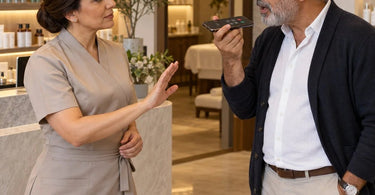
Elevate your work with the right tools... and sometimes the most important tool in your spa is a perfectly timed, politely delivered sentence. Picture this: the Serenity Essentials are in place, the treatment room is beautifully prepared, and your client is finally settling into a peaceful experience. Suddenly, a booming voice announces from a smartphone, “CAN EVERYONE HEAR ME?” Congratulations, your tranquil spa has apparently become a corporate conference room, and nobody remembered to send the esthetician an invitation.
Speakerphone calls during spa appointments create an awkward situation for professionals who want to be accommodating without sacrificing the atmosphere their business works so hard to maintain. The challenge is not simply dealing with a noisy phone. It is protecting other clients, maintaining treatment safety, respecting privacy, and setting boundaries without embarrassing the person responsible.
The good news? You do not need to become the spa police, confiscate anyone's phone, or deliver a dramatic speech about the meaning of relaxation. A thoughtful policy, a few practiced phrases, and consistent staff procedures can turn an uncomfortable interruption into a manageable customer service moment.
Why Speakerphone Calls Are More Than a Minor Spa Annoyance
A speakerphone conversation affects more than the person holding the phone. Sound travels through hallways, under treatment room doors, and into relaxation areas where other guests may be enjoying massages, facials, waxing services, or quiet recovery time.
Clients book professional spa services for many reasons, including relaxation, personal care, stress relief, and a break from daily distractions. They generally do not expect to become unwilling participants in someone else's budget meeting, family discussion, or enthusiastic debate about what to order for dinner.
For spa operators, the consequences can include interrupted treatments, distracted practitioners, frustrated guests, scheduling delays, and complaints about the overall experience.
There are also privacy considerations. An unexpected speakerphone call could expose personal information belonging to the caller, the person on the other end, nearby clients, or the treatment professional. If the call includes video, additional concerns arise around filming, consent, and the privacy of other guests.
The central principle is simple: a client is welcome to handle an important call, but that does not automatically make the treatment room an appropriate place to conduct it.
What to Say When a Client Answers on Speakerphone
The best response is immediate, friendly, and matter-of-fact. Avoid waiting until the conversation has continued for several minutes. The longer the call goes uninterrupted, the more awkward it can feel to intervene.
If a client activates speakerphone during a facial, massage, or another treatment, pause at an appropriate and safe point and calmly explain the policy.
Try this: “I completely understand that you may need to take that call. We keep our treatment rooms quiet for everyone's comfort, so I would be happy to pause while you step into our designated phone area.”
This statement works because it acknowledges the client's needs, clearly identifies the boundary, and offers a practical solution.
If the caller is already speaking loudly, avoid competing with the conversation. Wait for a natural opening, use a calm voice, and speak directly to the client rather than addressing the person on the phone.
For a shorter interruption: “Would you mind taking that off speaker? We want to keep the spa peaceful for our other guests. Thank you!”
When the spa's policy prohibits calls entirely in treatment areas, be equally clear about that restriction. Asking someone to turn down the speakerphone is not enough if ordinary phone conversations would still disturb nearby clients.
Set the Expectation Before the Phone Rings
Preventing an interruption is usually easier than resolving one halfway through a service. Spa phone etiquette should be communicated before guests reach the treatment table.
Consider including a concise reminder in appointment confirmations, pre-visit instructions, reception signage, and the check-in conversation.
Appointment confirmation wording: “To maintain a peaceful environment for all guests, please silence your phone before entering our treatment and relaxation areas. If you need to make or receive a call, our team can direct you to an appropriate location.”
Reception reminder: “Before we get you settled, please switch your phone to silent. We ask everyone to take calls outside our quiet treatment areas.”
Treatment room reminder: “You are welcome to keep your phone with your belongings, but we ask that calls wait until after your service. If something urgent comes up, just let me know and we can pause safely.”
Clear communication is especially valuable for first-time visitors, group bookings, bridal parties, and clients who may not be familiar with spa etiquette.
Small environmental details can reinforce these expectations. Thoughtfully arranged Reception Furniture, conveniently placed personal storage, and discreet signs can make the quiet-zone policy feel like a natural part of the professional experience rather than an unexpected restriction.
What If the Client Says the Call Is an Emergency?
Not every phone interruption is frivolous. A client may be waiting for news about a family member, a childcare issue, or another genuinely urgent situation.
The goal is not to determine whether the emergency deserves your approval. It is to accommodate the situation without jeopardizing treatment safety or the experience of other guests.
A useful response is: “Of course, please take care of what you need to. Let me pause the treatment safely, and I can show you where you can speak privately.”
Depending on the service, this could mean removing active equipment, placing tools in a safe position, securing product containers, or helping the client sit up only when it is appropriate.
Do not rush a client off a treatment table while a procedure is underway. During waxing, for example, complete or safely stop the current application before allowing sudden movement. When using electrical facial equipment, follow the device instructions and professional safety procedures before interrupting the service.
For operations involving Advanced Spa Equipment for Professional Use, technicians should have clear protocols for pausing services rather than improvising around a phone conversation.
An urgent call may also make continuing the appointment impractical. Explain the available options honestly, including whether the service can resume, must be shortened, or needs to be rescheduled under the business's established policy.
When a Client Refuses to End the Speakerphone Call
Some clients will immediately apologize and put their phones away. Others may insist that the call will only take a minute, even after the meeting has entered its third agenda item.
If the first polite reminder does not work, repeat the boundary without escalating the emotional temperature.
First reminder: “I understand you need to finish your conversation. We do need to keep speakerphone calls out of the treatment area, so let's pause while you take it elsewhere.”
Second reminder: “I am unable to continue the treatment while the call is active. We can resume when you are ready, provided there is enough time remaining in your appointment.”
If the behavior continues: “I would like to help you finish your appointment comfortably. Since we cannot continue with an active phone call, I am going to ask our manager to help explain the available options.”
Notice what these statements do not include. There is no sarcasm, accusation, or debate about the client's manners. The professional simply communicates what needs to happen before the service can continue.
If a client becomes threatening or abusive, prioritize staff safety, end the interaction when appropriate, and follow the business's escalation and incident procedures.
Should You Stop the Treatment Clock?
This is where a phone interruption becomes an operational issue rather than merely an etiquette concern.
If a client spends ten minutes on speakerphone during a scheduled 60-minute massage, should the practitioner extend the appointment? Should the client receive the full treatment anyway? Does the next guest have to wait?
The best answer is to establish a consistent policy before these situations occur.
Many appointment-based businesses benefit from a straightforward approach: the scheduled appointment window remains unchanged when a client voluntarily interrupts their treatment, unless the business chooses to make an exception.
For example, if a guest books a 60-minute appointment from 2:00 to 3:00 and takes a lengthy personal call, the appointment may still need to conclude at 3:00 to protect the next booking.
However, policies should account for circumstances such as provider delays, genuine emergencies, treatment-specific safety requirements, and any applicable consumer protection obligations.
A practical written policy might state: “Personal calls may require us to pause your service. Pauses initiated by the guest do not automatically extend the scheduled appointment, and shortened services are handled according to our published appointment policy.”
Train reception staff and practitioners to explain this consistently. Avoid surprising the client with a charge or reduced service that was never communicated.
Different Spa Services Need Different Responses
Although a consistent phone policy is important, the actual intervention should reflect what the professional is doing when the call begins.
Massage treatments: For massage therapists, a client talking on speakerphone can interfere with relaxation, communication about pressure, and maintaining a comfortable treatment environment. Practitioners should stop hands-on work at an appropriate point, maintain proper draping, and allow the guest to address the call outside the treatment space.
Well-prepared rooms using professional Massage & Wellness Products, clean linens, and comfortable positioning support a peaceful experience, but they cannot overcome a loud conversation from the treatment table.
Facials and advanced skincare: A phone call may cause a client to move their head, interrupt instructions, or reach toward their face while products or equipment are in use. Stop the active treatment step safely before addressing the call. Products and equipment from Advanced Facial Treatment Products for Salons & Spas should be used according to the manufacturer's procedures throughout any interruption.
Waxing services: A client unexpectedly reaching for a phone during a waxing application is not merely distracting. Movement can complicate product placement and removal. Practitioners working with Waxing Supplies for Professionals should maintain complete control of the treatment and stop at a safe point rather than trying to work around the conversation.
Manicures and pedicures: Nail professionals regularly encounter clients who want to multitask. A brief glance at a phone may be manageable during some steps, but speakerphone conversations can disturb neighboring stations and interfere with work requiring still hands. During services involving Professional Gel Polish or precision nail work, explain when the client must remain still and keep devices away from the work area.
Lash and brow treatments: Services that require closed eyes, precise positioning, or close proximity to sensitive areas are particularly unsuitable for phone distractions. Professionals using Lash & Brow Service Supplies should never compromise treatment instructions simply because a client wants to participate in a call.
Protect the Other Guests Without Creating a Scene
Imagine a client enjoying a quiet facial in one room while someone in the adjacent room is broadcasting a conversation about quarterly sales targets. The guest receiving the facial should not have to leave the treatment to ask for quiet.
Staff should address disruptions promptly rather than relying on other clients to complain.
If a phone conversation is happening in a hallway or relaxation lounge, approach the caller discreetly and say: “I am sorry to interrupt. We have treatments underway nearby, so could I ask you to finish your call in our designated phone area? Thank you so much.”
Whenever possible, redirect the conversation before it becomes a repeated disturbance. Do not publicly announce that another guest complained, point toward the affected treatment room, or embarrass either client.
If another guest has already been disturbed, acknowledge the inconvenience privately. A simple statement such as “I apologize for the noise. We have addressed it and are working to maintain a quiet environment” is usually more constructive than a lengthy explanation about the offending customer.
Compensation should be handled according to your customer service policy and the actual impact on the service, not offered automatically every time someone's phone makes a sound.
Can Better Spa Equipment Help Control Noise?
Products cannot replace good boundaries, but the physical environment can make those boundaries easier to maintain.
Consider the role of room layout, doors, hallway traffic, background sound, and the location of reception areas. A speakerphone conversation directly outside a treatment room is considerably more disruptive than one in a separated, designated calling space.
Subtle background sound from appropriately placed white noise machines or spa sound systems may help reduce the perception of routine hallway activity. However, sound masking is not a license to permit loud phone calls. Volume should remain comfortable and should never interfere with client instructions, staff communication, or safety.
Other details help create a more relaxing setting. Comfortable Salon & Spa Bedding, quality High-Quality Towels, and carefully selected Aromatherapy Supplies can contribute to the overall atmosphere when appropriate for the service and client.
Convenient Lockers can also encourage clients to secure personal belongings before treatments, reducing the temptation to keep checking a phone throughout the appointment.
Remember that some clients need their phones accessible for important personal reasons. Offer reasonable options rather than requiring everyone to surrender their devices.
Create a Phone Etiquette Policy That Staff Will Actually Use
A policy nobody can remember is about as useful as a massage table with three legs. Keep your phone etiquette guidelines short, practical, and easy to explain.
A strong spa policy should address the following:
- Quiet zones: Identify where calls and speakerphone conversations are prohibited, including treatment rooms, relaxation lounges, and shared service areas.
- Acceptable calling locations: Clearly identify where guests may take necessary calls without disturbing treatments.
- Emergency exceptions: Explain how employees should help guests manage urgent communications.
- Appointment timing: State how guest-initiated interruptions affect the remaining service time.
- Privacy: Establish rules for video calls, audio recording, and photography, especially where other guests may be present.
- Staff authority: Give service providers clear permission to pause unsafe or disruptive treatments and involve management when necessary.
- Consistent enforcement: Apply the rules fairly to new guests, regular clients, group bookings, and VIP customers.
It is particularly important that employees know they have management support. A practitioner should not have to choose between maintaining professional standards and risking criticism for politely enforcing a published policy.
How to Train Your Team Without Making Everyone Sound Robotic
Employees are more likely to enforce boundaries when they have practiced the words they need.
Include phone etiquette scenarios in staff meetings and onboarding. Role-play common situations, including a client taking a work call during a massage, a guest speaking loudly in the relaxation lounge, and someone starting a video conference during a manicure.
Encourage team members to use natural language while preserving the same core message: acknowledge the need, explain the boundary, provide an alternative, and protect the treatment schedule.
Receptionists can introduce the policy. Service providers can reinforce it before treatment begins. Managers should handle repeated refusal, disputes about appointment time, or behavior that makes employees uncomfortable.
A useful training exercise is to have each employee practice a response that takes no longer than 15 seconds. The goal is confidence, not memorizing a three-page customer service monolog.
Consider maintaining a short internal procedure alongside other spa operations documents, including equipment safety instructions, sanitation procedures, and professional conduct standards. Having reliable Supplies for Salon & Spa Business Success helps the team manage daily services, while clear operating procedures help maintain consistency.
What About Clients Who Insist They Can Multitask?
Every spa professional eventually meets a guest who believes they can answer emails, negotiate a contract, participate in a group call, and receive a relaxing facial simultaneously.
Impressive ambition? Absolutely. Appropriate treatment behavior? Not necessarily.
Instead of arguing about whether the client personally finds speakerphone relaxing, focus on the broader environment and professional requirements.
Try saying: “I understand that you are comfortable taking calls during your appointment. We do have a quiet-room policy because sound carries to other guests, and I also need your full cooperation during certain treatment steps.”
If the client explains that staying available by phone is essential, discuss suitable accommodations before beginning the service. Possibilities may include scheduling a shorter appointment, choosing a service that allows more flexibility, or selecting a time when they are less likely to be interrupted.
These alternatives are especially useful for clients who regularly schedule appointments during their workday. However, do not promise an exception that would violate your treatment safety standards or disrupt other guests.
How to Handle a Repeat Speakerphone Offender
One unexpected call is an interruption. Repeated speakerphone conversations after several reminders are a pattern that deserves a more deliberate response.
Start by documenting relevant facts according to your business's recordkeeping and privacy practices. Note when the incident occurred, the policy communicated, whether the treatment was interrupted, and any scheduling consequences. Avoid unnecessary personal details about the actual phone conversation.
Before the client's next appointment, have a manager communicate the expectations privately.
Suggested message: “We appreciate having you as a guest and want every visit to be enjoyable. During your previous appointments, phone conversations interrupted the quiet treatment environment. For future visits, we will need calls to take place outside the treatment area. We are happy to help you plan around any important calls.”
For repeated violations, managers may need to explain that services cannot continue unless the client follows the policy. Any decision to restrict future bookings should be consistent with applicable requirements and applied fairly.
A calm, documented conversation is more effective than allowing resentment to accumulate until a frustrated employee finally delivers a speech worthy of reality television.
Turn an Awkward Moment Into Better Client Service
Handled correctly, a speakerphone interruption can actually demonstrate professionalism. Guests notice when employees are respectful, confident, and protective of the atmosphere.
The difference often comes down to how the message is delivered. Compare an irritated “You cannot do that in here!” with a welcoming “Let me help you find a private place for your call so we can keep the treatment area peaceful.”
Both statements address the same behavior, but only one reinforces the hospitality clients expect from a professional spa.
When the guest returns, avoid dwelling on the interruption. Briefly confirm the remaining appointment time, check whether they are ready to resume, and return your attention to delivering an excellent service.
If the appointment needs to end early, explain what was completed, what could not be completed, and what follow-up options are available. Accurate communication prevents confusion at checkout.
Quick Answers to Common Spa Speakerphone Questions
Is it rude to take a speakerphone call in a spa? In shared treatment and relaxation areas, speakerphone calls are generally considered disruptive because other guests can hear the conversation. The best approach is to use a designated calling area and follow the spa's posted etiquette rules.
Can a spa ask a client to stop talking on the phone? Yes, spas can establish reasonable conduct policies for their premises and services, subject to applicable laws and accommodation requirements. Staff should explain these expectations clearly, politely, and consistently.
Should a massage therapist continue working while a client is on speakerphone? Not when the conversation interferes with professional communication, safety, privacy, or the spa's quiet-room policy. The therapist should pause at an appropriate point and explain how the service can resume.
What if the client needs to receive an urgent call? Allow the client to address the situation, pause the service safely, and direct them to an appropriate private area. Explain any scheduling consequences without making the client feel punished for an emergency.
Should the spa extend an appointment because of a phone call? Not automatically. The decision should follow the business's disclosed scheduling policy, the reason for the interruption, and the needs of the next scheduled guest.
Can clients use headphones instead of speakerphone? Headphones can reduce noise from the other caller, but the guest's own voice may still disturb others. If the spa prohibits conversations in treatment rooms, switching to headphones does not eliminate that restriction.
What if a client starts a video call? Address it immediately and discreetly. Video calls may create additional privacy concerns, particularly when other guests, changing areas, or treatment activities could appear on camera. Follow the spa's recording and photography policy.
Protect the Peace Without Losing Your Personality
Great spa hospitality does not mean saying yes to every request. It means creating an environment where clients feel cared for while professionals can work safely and comfortably.
Speakerphone calls are one of those small operational challenges that can feel enormous when they happen in the middle of a carefully planned treatment. Fortunately, the solution rarely requires confrontation. Clear advance communication, reasonable alternatives, supportive management, and a consistent policy can prevent most incidents from becoming bigger problems.
For spa and salon owners building a more polished client experience, the details matter. From comfortable treatment furniture and organized workstations to dependable Spa Essentials for Professionals, your physical environment supports the service standards your team delivers every day.
Pure Spa Direct helps spa, salon, massage, waxing, nail, and beauty professionals source the supplies and equipment they need for their businesses. We are a professional distributor, not a manufacturer, and understand that creating an inviting service environment involves more than selecting products. It also takes thoughtful procedures and confident customer care.
At the end of the day, your clients booked a spa treatment, not front-row seats to someone else's conference call. Protect the quiet, keep your boundaries friendly, and let the most memorable sound in the treatment room be a satisfied client saying, “That was exactly what I needed.”
