
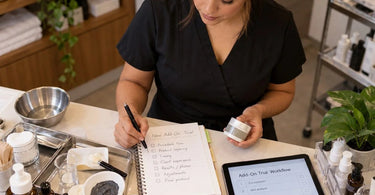
Effortless results for every professional... sound wonderful, but even the cutest little service add-on can create surprisingly large operational headaches if it jumps straight from idea to menu. A new scalp ritual, hand treatment, brow enhancement, cooling eye service, foot scrub, or massage upgrade may look simple from the client side, yet behind the treatment-room door it can affect timing, supplies, pricing, training, cleanup, booking, and the provider's entire service rhythm. Before ordering a mountain of Must-Have Supplies for Salon & Spa Business Success and announcing your fabulous new upgrade to everyone with a pulse, give that add-on a proper trial workflow.
A trial workflow is essentially a dress rehearsal for the service. Instead of immediately putting a new enhancement on the permanent menu, the team tests it under realistic conditions, records what happens, fixes awkward steps, and decides whether the add-on actually deserves a permanent spot. It is much easier to discover that your supposedly five-minute enhancement takes seventeen minutes during a controlled trial than while your next three clients are sitting in reception wondering whether you moved to another state.
Why New Add-Ons Need More Than a Good Idea
Add-ons are attractive because they can personalize an appointment and potentially increase the value of an existing service without requiring an entirely separate booking. That makes them useful across facials, waxing, massage, nails, brows, lashes, hair, barbering, and body treatments. However, the phrase "it only adds a few minutes" has probably caused more scheduling optimism than anyone would care to admit.
The real workflow includes preparation, consultation, application, processing time, removal, sanitation, restocking, documentation, and checkout. A provider may also need extra Professional Cotton, Sponges, and Wipes for Salons & Spas, Applicators & Spatulas, bowls, towels, gloves, or disposable supplies. Individually, those steps may seem tiny. Together, they can turn a quick upgrade into the scheduling equivalent of opening a junk drawer and discovering that absolutely nothing fits.
Start With One Clear Version of the Add-On
Before testing anything, define exactly what the enhancement includes. Avoid letting every provider invent a slightly different version during the trial. If one esthetician performs a six-minute treatment using one product and another creates a fifteen-minute mini-facial involving four products, you are not testing one add-on. You are testing two cousins who happen to share a name.
Write down the intended sequence. Identify which base services can receive the add-on, which supplies are required, approximately how much product should be used, what preparation is necessary, and how the provider should finish the service. This becomes the temporary protocol that the team can actually evaluate.
For example, a facial enhancement might require Mixing Bowls, professional applicators, towels, and products from your Premium Skincare Products for Spas and Salons assortment. A waxing enhancement could involve specific Pre & Post-Waxing Products. A manicure upgrade might use Cuticle Oil, a scrub, or additional nail-treatment products. The details matter because those details become your real cost and real timing.
Test the Add-On on a Small Scale First
A controlled pilot is usually much more informative than an immediate full-menu launch. Choose a limited number of providers, services, appointments, or days and run the enhancement repeatedly. The goal is not simply to find out whether clients say they like it. You also want to learn whether the service fits the business.
During testing, watch the clock from beginning to end. Include setup and cleanup, not merely the glamorous part in the middle. If the advertised ten-minute add-on needs four minutes of preparation beforehand and another five minutes of sanitation afterward, management needs to know that before assigning its menu duration.
This is especially important when equipment enters the picture. A service using Towel Steamers, Hot Stones and Warmers, Facial Steamers, or other professional devices may require warming, cooling, positioning, sanitation, or room reset time. Equipment apparently has never heard the phrase "just squeeze it in."
Measure Product Usage Instead of Guessing
A beautiful add-on can still be a poor menu choice if providers use wildly different amounts of product. Trial appointments give the business an opportunity to determine realistic portion sizes and cost per service.
Use consistent dispensing methods where practical. Measure approximately how many applications come from a jar, bottle, packet, cartridge, or other professional format. Include disposables such as cotton, wipes, gloves, table protection, applicators, and laundering needs. Browse items such as High-Quality Towels, Protective Gloves & Masks for Salon and Spa Professionals, and Hygienic Table Paper for Waxing, Spa & Massage Tables when building a realistic supply list.
A tablespoon here and an extra pair of disposables there might seem insignificant until hundreds of appointments are involved. Small unit-cost surprises become impressively less adorable at volume.
Check Whether the Add-On Disrupts the Core Service
An enhancement should improve the appointment rather than hijack it. During the pilot, observe whether the provider can integrate it smoothly into the original treatment.
Ask practical questions. Does the enhancement fit during an existing processing period? Does it force the provider to leave the room repeatedly? Does the client need to reposition? Does equipment suddenly block a walkway? Does adding another bowl or tray clutter the workstation? Does the provider have enough room to reach everything without performing accidental treatment-room yoga?
Workstation organization matters particularly in compact spas and salons. Testing can reveal whether additional storage, carts, Spa Tools & Implements for Professionals, linens, or equipment need dedicated locations before launch.
Build the Client Conversation Into the Trial
Operational testing is only half the job. Providers also need a natural way to explain the enhancement. Clients should understand what is being added, why it may complement their scheduled service, how much it costs, and whether it changes appointment time.
Create one or two simple recommendation phrases that providers can adapt rather than forcing everyone into a robotic script. The recommendation should connect the add-on to the client's goals and consultation rather than sounding like an unexpected checkout ambush.
The pilot period provides a chance to learn which explanation clients immediately understand and which description generates the facial expression universally translated as, "I have absolutely no idea what you just said." Adjust the wording before printing menus, modifying online booking, or promoting the service heavily.
Train the Team Before Everyone Starts Selling It
Once the test workflow feels solid, teach the same process to every provider who will perform the enhancement. Demonstrate preparation, application, timing, finishing, sanitation, product portioning, and room reset.
If possible, let team members practice before performing the add-on on paying clients. This is particularly useful for enhancements connected to specialized categories such as Lash & Brow Service Supplies, Professional Nail Care Collections, massage services, advanced skin treatments, or waxing.
Consistency matters because the client should receive essentially the same promised experience regardless of which qualified team member performs it. An add-on should not be luxurious on Tuesday, mysterious on Wednesday, and apparently an entirely different species by Saturday.
Evaluate Sanitation and Reset Requirements
Every service addition should also pass a sanitation reality check. List everything that touches the client, provider, treatment surface, workstation, or product during the add-on. Determine what is disposable, what must be cleaned and disinfected, what must be laundered, and how that reset fits between appointments.
Make sure the treatment area has sufficient Professional Cleaners & Disinfectants for Salons and Spas and whatever service-specific supplies are required by your facility's protocols and applicable rules. A profitable enhancement that creates an impossible turnaround process is not actually a streamlined enhancement.
Calculate the Price After You Know the Real Workflow
Pricing too early is one of the easiest mistakes to make. The price should be informed by what the trial reveals, including product consumption, disposables, labor, added appointment time, cleanup, equipment use, and the overall value of the enhancement.
Suppose management originally imagined an eight-minute add-on. After several trials, the team discovers that it reliably requires fourteen minutes from preparation through reset. That is valuable information. Management can adjust the protocol, change the price, change the booking duration, combine certain steps with the core service, or decide the idea does not fit the menu.
The trial therefore protects the business from launching a price based on wishful mathematics. Wishful mathematics is fun right up until payroll.
Create a Simple Trial Scorecard
You do not need a research laboratory, three clipboards, and someone wearing safety goggles. A straightforward scorecard can capture what management needs. After each trial, record the scheduled base service, actual added time, approximate product use, supplies consumed, provider feedback, client feedback, operational problems, and whether the enhancement was easy to recommend.
After several appointments, patterns should become visible. Maybe the service is consistently fast and clients love it. Maybe clients enjoy it but providers need a better workstation setup. Maybe one product creates unnecessary cleanup. Maybe the treatment works wonderfully with facials but makes no operational sense with another service.
Those findings allow you to refine the enhancement before scaling it across the business.
Test Inventory Levels Before Promotion Begins
A successful launch can produce its own problem: suddenly everybody wants the add-on and the spa has enough supplies for approximately six enthusiastic humans.
Use the trial to estimate inventory consumption. Determine the approximate number of appointments available from each professional-size unit and establish sensible reorder points. If the enhancement needs several supporting items, keep them together on an internal restocking checklist.
Pure Spa Direct distributes professional products across spa, salon, waxing, massage, nail, barber, skincare, lash, brow, wellness, furniture, equipment, and disposable-supply categories, making it easier for professionals to compare the supplies involved when planning new service workflows. The important part is ordering based on actual service usage rather than the universally dangerous purchasing strategy known as "that looks like enough."
Define What Counts as a Successful Trial
Before the pilot ends, decide what information earns the add-on a permanent place on the menu. Success might include manageable timing, consistent product cost, positive client response, provider confidence, reasonable cleanup, sufficient demand, and compatibility with existing appointments.
Not every test has to become a launch. Rejecting or redesigning an enhancement after a pilot is not failure. It is exactly what the pilot was designed to accomplish. It is far better to discover weaknesses after ten controlled appointments than after buying supplies, redesigning menus, updating online booking, training the entire staff, and explaining to clients why the exciting new service has mysteriously vanished.
Then Launch the Version You Actually Tested
Once the workflow is reliable, document the final protocol and use that version for training, pricing, booking, inventory planning, and promotion. Specify compatible services, expected duration, required products, preparation, sanitation, and any client-selection considerations relevant to your professional scope and procedures.
Then the fun part can begin. Add the enhancement to the menu, introduce it during appropriate consultations, incorporate it into booking options, and make sure the team understands how to describe it consistently.
If the add-on requires new treatment supplies or equipment, explore categories such as Spa Essentials for Professionals, Advanced Facial Treatment Products for Salons & Spas, Professional Massage & Wellness Products, Waxing Supplies for Professionals, and Manicure Essentials while developing the supporting workflow.
A Tiny Add-On Deserves a Real Launch Plan
A service enhancement may occupy only a few lines on the menu, but it touches far more areas of the business than its size suggests. Testing the workflow first gives spa and salon professionals the opportunity to understand timing, cost, client communication, staff training, inventory, sanitation, and room flow before putting the service in front of the entire clientele.
The goal is not to make launching new ideas painfully complicated. It is the opposite. A short, controlled trial makes the permanent launch easier because the annoying surprises have already had their moment in the spotlight. Test it, time it, price it, refine it, train it, and then launch it with confidence. Your providers, your schedule, your inventory shelves, and the poor receptionist trying to keep the whole operation running will all appreciate the effort.
