
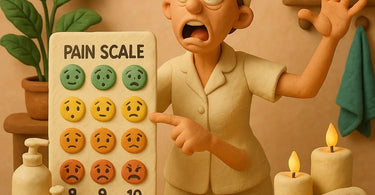
Innovation starts with smart choices... like never asking "On a scale of 1 to 10, how much does this hurt?" in the same tone you'd use to read a microwave manual. Let's be real: that pain scale question can feel about as comforting as a cold wax strip if delivered wrong. But what if you could transform that mandatory check-in from clinical interrogation to compassionate conversation? The magic happens when you blend clinical precision with human connection—using the pain scale as a gateway to truly understanding your client's experience rather than just checking a box. Your clients aren't robots (even if they sometimes lie there like one during a Brazilian wax), and your approach shouldn't make you sound like one either.
Mastering this delicate balance means diving into the nuances of verbal and non-verbal communication, creating a comfort-first environment, and having the right products on hand to actually respond to what your clients reveal. Whether you're performing brow services or deep tissue massage, the pain scale isn't just about assessment—it's about building trust that keeps clients returning to your spa or salon.
Why the Pain Scale Feels Robotic (And How to Fix It)
The standard pain scale question fails because it's often delivered as a closed-ended question with zero context. You might as well be asking for their PIN number. The fix? Context and conversation. Instead of abruptly asking for a number, frame it within a caring dialogue: "I want to make sure you're completely comfortable throughout this hot stone massage. Some areas might be more sensitive than others, so I'll check in periodically. On a scale where 1 is barely noticeable and 10 is make-it-stop-now, how are you feeling right now?" This approach explains why you're asking and what the numbers mean, making it collaborative rather than interrogative.
Watch for non-verbal cues too—the clenched fists during soft wax application or the held breath during extractions often tell you more than the number they give. One client's "5" might be another's "8," so pay attention to their baseline reactions. If you notice tension, acknowledge it: "I noticed you flinched when I worked on that shoulder—should we adjust the pressure or focus more on that area?" This shows you're attentive beyond just the number they verbalize.
The Comedy of Pain: Keeping It Light Without Minimizing Discomfort
Humor can be your secret weapon against robotic interactions—when used appropriately. Self-deprecating humor works wonders: "I promise this microdermabrasion treatment won't feel like sandpaper on sunburn, despite what your friend might have told you!" Or try relatable analogies: "If 1 is floating on a cloud and 10 is stepping on LEGO bricks barefoot, where are we right now?" These creative scales create momentary distraction while still gathering essential information.
Just remember: never laugh at their pain—laugh with them about the universal experience of discomfort. If a client jokes about their low pain tolerance during hard wax treatments, join them: "Hey, I cry during puppy commercials—we all have our things!" Then immediately follow up with actionable comfort: "Let me grab our numbing spray to make this more manageable." This balances humor with genuine care.
Beyond the Number: What Clients Really Mean When They Answer
Clients often underreport pain because they don't want to be "difficult" or they believe discomfort is just part of the process. Your job is to read between the numbers. When someone says "4," but their knuckles are white from gripping the table, they might actually be at a 7. Probe gently: "I appreciate you being tough, but my goal is your comfort—would you like me to adjust anything?" This gives permission to be honest.
Different services require different interpretations too. A "6" during a cupping therapy session might be therapeutic, while a "6" during a facial steam indicates something's wrong. Explain this difference: "During this RF treatment, we want to feel some warmth—ideally around a 3-4 level. Let me know if it goes beyond that." This educates clients about what to expect and when to speak up.
The Product Connection: Having Solutions at Your Fingertips
Asking about pain becomes meaningless if you don't have solutions ready. Your check-in should directly connect to actionable comfort measures. When a client reports discomfort during waxing, immediately reach for your high-quality ItalWax with soothing properties or your post-wax products to calm the skin. For massage clients, adjust your pressure or apply a heated massage tool to ease tense muscles.
Stock your treatment room with comfort-enhancing products: calming essential oils for diffusers, heated table warmers for physical comfort, and sanitizing sprays visibly placed to reassure anxious clients. When clients see you reaching for specialized products to address their comfort, it validates their experience and demonstrates professional care beyond just asking questions.
Scripting Natural Conversations: What to Say Instead
Ditch the robotic "Number?" for these more natural alternatives:
For waxing services: "Everyone's sensitivity is different—would you describe what we're feeling as mild tingling, warm sensation, or sharp moment?" This gives you more useful information than a number alone.
For massage: "I want to work with your comfort zone—should I lighten up, maintain this pressure, or go deeper where it feels good?" This offers control rather than just assessment.
For advanced treatments: "This chemical peel should feel like mild itching or warmth—if it moves to stinging or burning, that's my cue to adjust. How are we feeling?"> This sets expectations while checking in.
Always pair the question with observable feedback: "I noticed you relaxed when I worked on that knot—should we spend more time there?" This shows you're attentive to their body's responses beyond their words.
Training Your Team: Making Compassionate Check-Ins Standard Practice
Consistent client experience requires team-wide understanding. Role-play different client scenarios during staff meetings—the stoic client who minimizes discomfort, the anxious client who amplifies it, and the confused client who doesn't understand the scale. Practice responding with both verbal reassurances and practical solutions from your product lineup.
Create a comfort menu that technicians can reference: "For reported pain level 5-6 during waxing: apply soothing ingrown hair serum; for level 7-8: use sugaring alternative on sensitive areas."> This standardized approach ensures every team member can deliver both assessment and solution.
Finally, document what works! When you discover a particular massage cream or technique consistently lowers reported pain levels, share that success across your team. The art of the pain scale evolves with practice and collaboration.
The Reward: Transforming Pain Conversations into Trust Building
When executed with artistry rather than automation, the pain scale check-in becomes more than a mandatory question—it becomes a trust-building ritual. Clients remember how you made them feel more than the exact pressure used during their body treatment or the specific number they reported during their lash lift. They remember that you noticed, adjusted, and cared.
This attention to comfort communication directly impacts your bottom line through repeat bookings, positive reviews, and word-of-mouth referrals. Because in the end, people don't just come for our technical skills—they come for the experience of feeling genuinely cared for by professionals who know how to ask "How does this feel?" like they actually want to know the answer.
:%20How%20to%20Master%20Client%20Comfort%20Conversations)