
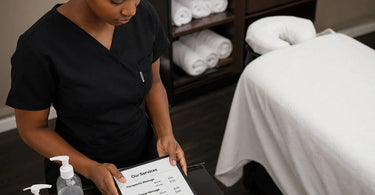
Pros choose this for client satisfaction, but let's be honest, your service menu isn't a secret decoder ring for a clandestine beauty operation. Yet, so many of us in the spa and salon world are guilty of turning our menus into a confusing maze of technical terms that would make a doctor's prescription look like a children's book. You know the vibe: 'We offer a holistic, non-invasive dermaplaning-infused hydrofacial with a lymphatic drainage massage, followed by a high-frequency galvanic current treatment to stimulate collagen production.' While that description might make you feel like a brilliant scientist, your client is probably hearing, 'Blah blah blah expensive, blah blah blah, I'm scared, do I need a medical degree to get a facial?' We're here to tell you, honey, if your clients need Google Translate to understand your menu, it's time for a serious glow-up on your marketing. That's why we're diving deep into the all-important question: Why Service Menus Should Avoid Industry Jargon.
Let's face it, the beauty industry is obsessed with its own language. We throw around words like 'microcurrent,' 'radio frequency,' 'biological peel,' and 'phototherapy' like we're at a Star Trek convention. But here's the tea: your average client, the one who just wants to relax and maybe not look like a stressed-out goblin, doesn't care about the science fair. They care about results. They care about how they feel. Your service menu is the front door of your business, and if it looks like the entrance to a high-security lab, you're going to scare away a lot of potential loyal clients. It's time to ditch the jargon and start speaking their language. Think of it as translating your brilliance into pure, client-attracting magic.
The Problem with Jargon: You're Not Impressing Anyone (Except Maybe Yourself)
Let's be real for a hot second. When you load your service menu with industry jargon, you're not showcasing your expertise—you're creating a barrier. Clients don't want to feel stupid. They want to feel pampered and understood. When they see a word they don't recognize, their brain immediately goes into 'am I about to get ripped off?' mode. It's the same reason why a restaurant menu that says 'artisanally crafted, hand-foraged, deconstructed mille-feuille' makes people roll their eyes and order a burger instead of just calling it a fancy pastry. Clients want clarity. They want to walk into your luxury spa, look at your offerings, and instantly see a solution to their problems. They don't want to be confused. They want a menu that whispers sweet nothings about glowing skin and stress-free bliss, not one that screams 'I have a thesaurus and I'm not afraid to use it.' So, let's swap 'facial with advanced exfoliation' for 'Radiant Glow Face Treatment' and watch the bookings fly in.
The Human Connection: Because Clients Are People, Not Lab Experiments
At the end of the day, your business is built on relationships and the human touch . A client who feels understood is a client who comes back (and brings their friends). Jargon creates distance, and your goal is to create connection. When you describe a service as a 'Relaxing Back, Neck, and Shoulder Massage with Hot Stones,' clients can immediately visualize a warm, soothing experience. If you call it a 'Thermal Basalt Therapy for Myofascial Release,' they might picture a construction site. The point is to evoke an emotion, not a lecture. When your menu speaks to their desires—'Escape the daily grind,' 'Restore your natural glow,' 'Feel like yourself again'—you build instant rapport. Plus, it makes your consultation process way easier. Instead of spending ten minutes explaining what a 'galvanic machine' is, you can say, 'This treatment uses a gentle current to help your skin absorb our luxurious serums, giving you that fresh, dewy look you've been craving.' You feel me?
Boosting Sales with "What's in it for Me?"
Industry jargon is the arch-nemesis of the add-on sale. Think about it. If you're already confused by a service description, you're not exactly going to be eager to spend more money on the 'optional upgrade.' However, if you frame it as a benefit, your clients will practically be begging to hand over their credit cards. This is where the magic of clear, benefit-driven copy comes in. Instead of just listing 'Microdermabrasion,' describe the service as 'Instant Skin Resurfacing to reveal a brighter, smoother, and more even complexion.' Suddenly, everyone who wants to look like they got eight hours of sleep (even though they didn't) will be interested. You can then use that to guide them to a specific brand that your advanced spa equipment can support, like our amazing Murad Clinical Skincare line for post-treatment care. Link that benefit directly to the result they can see and feel, and watch your average ticket soar. It's the difference between selling a 'treatment' and selling a 'transformation' .
How to De-Jargon Your Menu and Start Winning
So, how do you fix a jargon-filled menu without starting completely from scratch? It's simpler than you think. First, go through your entire menu and highlight every single technical word. Then, ask yourself: 'If I was a client who just got off a 10-hour shift, would I know what this means?' If the answer is no, rewrite it in plain English. Instead of 'Dermaplaning,' say 'Smooth Skin Renewal Treatment (a gentle exfoliation that removes peach fuzz and dead skin, leaving your face silky-smooth).' Instead of 'Vichy Shower,' say 'Hydrotherapy Body Treatment (a luxurious, multi-jet shower experience that soothes tired muscles and washes away stress).' It's about making the experience sound as good as it actually is. And don't be afraid to add a little personality! Inject some humor and warmth to make your brand memorable. Remember, you are the expert, but your menu is the friendly tour guide, not the boring technical manual.
The Perfect Service Menu: A Match Made in Heaven
A well-designed service menu is a powerful tool that, when executed correctly, makes choosing a service feel like a delightful treat, not a complex decision. It should guide clients through their options, highlighting the benefits and making it easy to say 'yes' to a bit more indulgence . You can organize your menu by client goals—like 'Stress Relief,' 'Radiant Skin,' or 'Full Body Tune-Up'—instead of department. This makes it intuitive and client-centric. It's the equivalent of walking into an elegant boutique versus a messy warehouse. The boutique invites you in; the warehouse overwhelms you. Your menu should be a beautiful, inviting boutique that showcases the incredible work you do. And remember, clear menus also help your staff. When front desk and service professionals can easily explain services in simple terms, it reduces confusion and builds confidence on both sides of the appointment .
Putting It All Into Practice: Real-World Examples
Let's take a classic example. You offer a massage. Instead of listing 'Swedish Massage,' frame it as 'Relaxation Massage: Melt away tension and stress with long, flowing strokes designed for a deeply calming experience. Perfect for first-time guests or anyone seeking pure Zen.' See the difference? The second description invites the client in and tells them exactly what they'll get out of it. The same goes for waxing. Instead of just 'Bikini Wax,' you can say 'Bikini Line Waxing: A fast and precise hair removal service to keep you feeling confident and beach-ready all year long. We use top-quality ItalWax to minimize discomfort.' You're not just offering a service; you're offering confidence. And if you are using products like ItalWax Pre/Post products, mention that in the description to show you're using the best to care for their skin. It's all about making the client the hero of the story.
This Isn't Dumbing Down—It's Leveling Up
There's a misconception that simplifying your language means you're 'dumbing down' your services. That couldn't be further from the truth. It's actually a sign of superior business acumen and stellar communication. You are the expert, and part of being a great expert is being an excellent translator. You're taking all your incredible knowledge and presenting it in a way that empowers and excites your client. A client who feels informed and at ease is a client who will trust you completely and often become a lifelong fan. They'll be so blown away by the experience that they won't care about the technical names—they'll just tell their friends, 'I went to this amazing place and my skin has never looked better!' And that, my friend, is the best marketing of all. So, trade the thesaurus for a heart-to-heart, and watch your business flourish. You got this!
)